Monday, June 18, 2007.
"In the midst of these pleasing ideas we should be unfaithful to ourselves if we should ever lose sight of the danger to our liberties if anything partial or extraneous should infect the purity of our free, fair, virtuous, and independent elections."
--John Adams (Inaugural Address, March 1797); Reference: Inaugural Addresses of the residents of the United States.
Tue. 6/19/07.
"The state governments have a full superintendence and control over the immense mass of local interests of their respective states, which connect themselves with the feelings, the affections, the municipal institutions, and the internal arrangements of the whole population. They possess, too, the immediate administration of justice in all cases, civil and criminal, which concern the property, personal rights, and peaceful pursuits of their own citizens."
--Joseph Story (Commentaries on the Constitution, 1833); Reference: Story, Commentaries on the Constitution, 191.
Wed. 6/20/07.
"Religion in a Family is at once its brightest Ornament & its best Security." [emphasis added, mine.]
--Samuel Adams (letter to Thomas Wells, 22 November 1780); Reference: The Writing of Samuel Adams, Harry Alonzo Cushing, ed., vol. 4 (225).
Thu. 6/21/07.
"In our progress toward political happiness my station is new; and if I may use the expression, I walk on untrodden ground. There is scarcely any part of my conduct which. may not hereafter be drawn into precedent."
--George Washington (letter to Catherine MacAulay, 9 January 1790); Reference: George Washington: A Collection, W.B. Allen, ed. (537).
Fri. 6/22/07.
"[T]he only foundation for a useful education in a republic is to be laid in religion. Without this there can be no virtue, and without virtue there can be no liberty, and liberty is the object and life of all republican governments."
--Benjamin Rush (On the Mode of Education Proper in a Republic, 1806); Reference: Original Intent, Barton (153); original Essays, Literary, Moral and Philosohpical, Rush (8).
Founders' Quote Daily is a service of The Patriot Post, the most widely read conservative journal on the Internet. If you would like to receive Founders Quote Daily, and this highly acclaimed Digest of news, policy and opinion delivered FREE by e-mail to your inbox, link to: Subscribe.
All of the Founders' quotes distributed by FQD have been thoroughly researched and authenticated by the Heritage Foundation. For a complete database of Founders' quotes on various topics, link to the Internet's most comprehensive resource page on our Founding documents Historic Documents and select Founders Quote Database.
Sunday, June 24, 2007


Black Hawk Troops Use More Than Body Armor to Keep Each Other Safe
20 Jun 07
By Spc. Alexis Harrison
2nd BCT, 1st Cav. Div. Public Affairs.
Black Hawk Troops Use More Than Body Armor to Keep Each Other Safe.
20 Jun 07
By Spc. Alexis Harrison
2nd BCT, 1st Cav. Div. Public Affairs.
BAGHDAD – For many of the Soldiers in the 2nd Brigade Combat Team, 1st Cavalry Division, the current 15-month tour in Iraq isn't their first. For the rest of the Soldiers in the “Black Jack” Brigade, having well-seasoned leaders can make all the difference.
While out on the streets every day, Soldiers from Troop B, 4th Squadron, 9th Cavalry Regiment, rely on much more than just the individual body armor systems they wear. They depend on each other to make it through daily situations and even the entire deployment.
 Staff Sgt. Angus Robinson from Copperas Cove, Texas, is on his third tour in Iraq. In 2004, he was with the 4th Infantry Division during the initial invasion. Six months later he was reassigned to the 1st Infantry Division to complete his second combat tour.
Although he was a truck gunner for the majority of his first two tours, he was still a non-commissioned officer who had to look out for what mattered most to him in a time of war: his Soldiers.
"Before, we had to fight through many places, not necessarily on a daily basis, but it was a regular thing," he said. "It was an eye-opening experience. It showed me the levels of responsibility you take on for your Soldiers are much different in combat than in a garrison environment."
For Robinson, the trips to Baqubah and Adiliyah were his first experience in combat. He would soon after find himself getting promoted to staff sergeant and getting assigned to the 1st Cavalry Division where he knew he'd once again have to lead Soldiers in a combat environment.
Through several trips to a combat zone, Robinson developed his own techniques of leadership. He borrowed a little from his past NCOs, a little from his experiences and a little from himself to become the leader he is today.
Sgt. Patrick Trujillo also has his share of combat experience. He served in the 2nd Armored Cavalry Regiment out of Fort Polk, La., during its trip to Iraq a few years ago. The Copperas Cove native is now an NCO with 2nd Platoon, Troop B "Night Stalkers."
His leadership techniques are similar to those of Robinson’s in the sense that he's taken a lot from his past leaders and he tries to give his Soldiers as much respect as he can.
He believes the more you show your Soldiers what it takes to be respected the more they'll respect him. He doesn't do it through punishments or lucrative awards.
"Lead by example," he said. "I always learned more from leaders who didn't mind getting their hands dirty."
More recently, Robinson was again reassigned. This time he didn't have to go as far as last time. He moved from one platoon to another within the "Black Hawk" Troop.
Not skipping a beat, Robinson was out on the streets with his team. The area where they patrol in Karkh used to be one of the worst in Baghdad. Robinson credits the hard work by leaders and his fellow Bradley tank crews for cleaning up the neighborhood.
Both Robinson and Trujillo remarked on how quickly the businesses, traffic and people came back to the area after a few months of being not much more than a ghost town where bodies were being found almost daily.
One more thing the two NCOs agreed upon was the satisfaction of seeing their Soldiers thrive and find success in combat.
"When I see my 'Joes' grow into larger roles, it gives me a satisfied feeling," Robinson said.
With a rather large grin on his face, Trujillo spouts: "It's a warm, fuzzy feeling."
Robinson said with leadership comes a lot more than giving orders. Besides patrolling a small area north of the International Zone, many responsibilities lie right on the base where they sleep.
Keeping up with vehicle and weapon maintenance, personal and personnel issues and training are just some of the things Robinson and Trujillo have to keep their Soldiers up to date on.
Robinson said as trivial as it might seem to the untrained eye, every step of the process every day helps mold young Soldiers into leaders and leaders into better leaders.
"In order to see [Soldiers] grow as individuals and leaders, you have to give them a sense of ownership. You have to allow them to take responsibility to the next level."
Robinson remarked that several of his Soldiers are itching for action. He can understand why, but he knows that patrolling a safe neighborhood is much easier than patrolling a volatile one.
One such Soldier is Spc. Ashley Hall. The Ardmore, Ala., native says that many of the challenges they face boil down to something much more simple than expected.
He said that being out in sector isn't necessarily the toughest part of the job. The true challenge lies in what's expected of him on a daily basis. Trujillo feels the same way.
"It's a big challenge having guys' lives in your hands," he said. "It's kind of scary but kind of satisfying in the same sense."
Photo - Staff Sgt. Michael Jenkins of 4th Squadron, 9th Cavalry Regiment, 2nd Brigade Combat Team, 1st Cavalry Division, greets an Iraqi soldier with whom he used to man a checkpoint with during a dismount to check on security measures June 7. He and his section from the 2nd Platoon "Night Stalkers" Troop B, now patrol Baghdad's Karkh District. Photo by Spc. Alexis Harrison.
Source: MNF-I.
******************************
This is a great article which tells of young man who learns about leadership by the example he sees all around him. This is one thing we could certainly use a lot more of!
Originally posted @ DoD Daily News-2.
By Spc. Alexis Harrison
2nd BCT, 1st Cav. Div. Public Affairs.
Black Hawk Troops Use More Than Body Armor to Keep Each Other Safe.
20 Jun 07
By Spc. Alexis Harrison
2nd BCT, 1st Cav. Div. Public Affairs.
BAGHDAD – For many of the Soldiers in the 2nd Brigade Combat Team, 1st Cavalry Division, the current 15-month tour in Iraq isn't their first. For the rest of the Soldiers in the “Black Jack” Brigade, having well-seasoned leaders can make all the difference.
While out on the streets every day, Soldiers from Troop B, 4th Squadron, 9th Cavalry Regiment, rely on much more than just the individual body armor systems they wear. They depend on each other to make it through daily situations and even the entire deployment.
 Staff Sgt. Angus Robinson from Copperas Cove, Texas, is on his third tour in Iraq. In 2004, he was with the 4th Infantry Division during the initial invasion. Six months later he was reassigned to the 1st Infantry Division to complete his second combat tour.
Although he was a truck gunner for the majority of his first two tours, he was still a non-commissioned officer who had to look out for what mattered most to him in a time of war: his Soldiers.
"Before, we had to fight through many places, not necessarily on a daily basis, but it was a regular thing," he said. "It was an eye-opening experience. It showed me the levels of responsibility you take on for your Soldiers are much different in combat than in a garrison environment."
For Robinson, the trips to Baqubah and Adiliyah were his first experience in combat. He would soon after find himself getting promoted to staff sergeant and getting assigned to the 1st Cavalry Division where he knew he'd once again have to lead Soldiers in a combat environment.
Through several trips to a combat zone, Robinson developed his own techniques of leadership. He borrowed a little from his past NCOs, a little from his experiences and a little from himself to become the leader he is today.
Sgt. Patrick Trujillo also has his share of combat experience. He served in the 2nd Armored Cavalry Regiment out of Fort Polk, La., during its trip to Iraq a few years ago. The Copperas Cove native is now an NCO with 2nd Platoon, Troop B "Night Stalkers."
His leadership techniques are similar to those of Robinson’s in the sense that he's taken a lot from his past leaders and he tries to give his Soldiers as much respect as he can.
He believes the more you show your Soldiers what it takes to be respected the more they'll respect him. He doesn't do it through punishments or lucrative awards.
"Lead by example," he said. "I always learned more from leaders who didn't mind getting their hands dirty."
More recently, Robinson was again reassigned. This time he didn't have to go as far as last time. He moved from one platoon to another within the "Black Hawk" Troop.
Not skipping a beat, Robinson was out on the streets with his team. The area where they patrol in Karkh used to be one of the worst in Baghdad. Robinson credits the hard work by leaders and his fellow Bradley tank crews for cleaning up the neighborhood.
Both Robinson and Trujillo remarked on how quickly the businesses, traffic and people came back to the area after a few months of being not much more than a ghost town where bodies were being found almost daily.
One more thing the two NCOs agreed upon was the satisfaction of seeing their Soldiers thrive and find success in combat.
"When I see my 'Joes' grow into larger roles, it gives me a satisfied feeling," Robinson said.
With a rather large grin on his face, Trujillo spouts: "It's a warm, fuzzy feeling."
Robinson said with leadership comes a lot more than giving orders. Besides patrolling a small area north of the International Zone, many responsibilities lie right on the base where they sleep.
Keeping up with vehicle and weapon maintenance, personal and personnel issues and training are just some of the things Robinson and Trujillo have to keep their Soldiers up to date on.
Robinson said as trivial as it might seem to the untrained eye, every step of the process every day helps mold young Soldiers into leaders and leaders into better leaders.
"In order to see [Soldiers] grow as individuals and leaders, you have to give them a sense of ownership. You have to allow them to take responsibility to the next level."
Robinson remarked that several of his Soldiers are itching for action. He can understand why, but he knows that patrolling a safe neighborhood is much easier than patrolling a volatile one.
One such Soldier is Spc. Ashley Hall. The Ardmore, Ala., native says that many of the challenges they face boil down to something much more simple than expected.
He said that being out in sector isn't necessarily the toughest part of the job. The true challenge lies in what's expected of him on a daily basis. Trujillo feels the same way.
"It's a big challenge having guys' lives in your hands," he said. "It's kind of scary but kind of satisfying in the same sense."
Photo - Staff Sgt. Michael Jenkins of 4th Squadron, 9th Cavalry Regiment, 2nd Brigade Combat Team, 1st Cavalry Division, greets an Iraqi soldier with whom he used to man a checkpoint with during a dismount to check on security measures June 7. He and his section from the 2nd Platoon "Night Stalkers" Troop B, now patrol Baghdad's Karkh District. Photo by Spc. Alexis Harrison.
Source: MNF-I.
******************************
This is a great article which tells of young man who learns about leadership by the example he sees all around him. This is one thing we could certainly use a lot more of!
Originally posted @ DoD Daily News-2.
Artillery battalion trades steel rain for hearts and minds
20 June 2007
Story and photo by Cpl. Rick Nelson
2nd Marine Division.
HADITHAH — The counter-insurgency coalition forces are conducting in Iraq calls for numerous military units to give up their traditional roles and pick up a different weapon. This is nothing new for artillery units, who, since the Battle of Fallujah in November of 2004, have often been called upon to put away their howitzers for rifles, police batons, and claims cards. All around Iraq, artillery batteries and battalions are serving as provisional rifle, military police, and civil military units. In Hadithah, it’s no different.
At the Hadithah Civil Military Operation Center, Marines assigned to 5th Battalion, 10th Marine Regiment, an artillery battalion based out of Camp Lejeune, N.C. assist the local populace with their civil matters.
 “This was a big change from our usual duties as a field artillery battalion,” said Cpl. Russell Mullis, Civil Affairs Group, Team 1, Detachment 1, 5/10. “Steel rain and hearts and minds are two entirely different missions, but we’re adapting very well.”
Until this year, CAG detachments were primarily staffed by reservists. This is the first year an artillery unit has civil affairs as their primary mission.
“We serve as a liaison between the local populace, and the coalition forces,” said Mullis. “We handle any claims and concerns from the populace, and process projects to rebuild the area.”
Civil Affairs Group, Team 1, Detachment 1, 5/10 is a part of Task Force 1st Battalion, 3rd Marine Regiment who fall under Regimental Combat Team 2. These Marines operate the CMOC, and patrol in Hadithah to conduct assessments and coordinate with local contractors.
“The Marines run two different missions, CMOC and civil affairs,” said Warrant Officer Harold Kiser, Officer-In-Charge, CAG, Team 1, Detachment 1, 5/10. “Our areas of concern and focus form the acronym SWEATS – schools, water, electricity, agriculture, transportation and sewage.”
The center conducts many daily tasks for the local nationals, a lot of which includes vehicle registration and badge distribution. CAG also compensates the locals for any damages inadvertently caused by military personnel during counter-insurgency operations.
“The sheer number of people who come through everyday is our biggest challenge,” added Mullis, a Winston-Salem, N.C.
On average, the CMOC will assist approximately 150 people a day. The largest number of local nationals serviced in one day was 220. CAG compensates for this number by issuing the local national a specific number after he or she has been searched at the entrance. This number puts them in a line to air their grievances and receive help. The Civil Affairs Team uses interpreters to overcome the language barrier.
“Our main problem here is a shortage of interpreters, but the ones we do have do a great job,” Mullis added.
Once a number is selected, an interpreter will speak with that person and determine how they can be helped. After speaking with the interpreter, the Marines will cater to the local national’s problem based on the situation.
Mullis recalled one such incident that occurred at the CMOC.
“A local national was driving his dump truck through a [traffic control point] in Haqlaniyah and misunderstood the Marines working there, and he went the wrong way,” said Mullis. “The way he went had road spikes, and he ended up destroying two of his tires.”
The driver was issued a claims card. When he arrived at the CMOC, he was given 381,500 dinar ($299.92 in American money).
“We searched through vendors to see what an average price was on the tires, which is how we came up with the amount,” he added. “That’s the usual way we complete our claims, and it seems to be working.”
This CMOC is another facet to this complex environment, and it’s something the CAG Marines know is vital to mission success.
“The CMOC provides a place for local nationals to interact with coalition forces, and without it, I think there would be a lot more friction with the people,” said Mullis.
Marines assigned to the CAG detachment continue to help the locals here and support the Lava Dogs of 1/3 in order to aid their counter-insurgency campaign.
Photo - Cpl. Russel Mullis, a Marine with the CAG detachment assigned to 1st Battalion, 3rd Marines, hands out paperwork to the local nationals at the Civil Military Operations Center in Hadithah.
Source: MNF-I.
Originally posted @ DoD Daily News-2.
This is a good article. We need to know more about the counter-terrorism that is taking place. One place to learn a lot is a site by the name of CounterTerrorismBlog. Visit it often. Have a blessed day.
Story and photo by Cpl. Rick Nelson
2nd Marine Division.
HADITHAH — The counter-insurgency coalition forces are conducting in Iraq calls for numerous military units to give up their traditional roles and pick up a different weapon. This is nothing new for artillery units, who, since the Battle of Fallujah in November of 2004, have often been called upon to put away their howitzers for rifles, police batons, and claims cards. All around Iraq, artillery batteries and battalions are serving as provisional rifle, military police, and civil military units. In Hadithah, it’s no different.
At the Hadithah Civil Military Operation Center, Marines assigned to 5th Battalion, 10th Marine Regiment, an artillery battalion based out of Camp Lejeune, N.C. assist the local populace with their civil matters.
 “This was a big change from our usual duties as a field artillery battalion,” said Cpl. Russell Mullis, Civil Affairs Group, Team 1, Detachment 1, 5/10. “Steel rain and hearts and minds are two entirely different missions, but we’re adapting very well.”
 Until this year, CAG detachments were primarily staffed by reservists. This is the first year an artillery unit has civil affairs as their primary mission.
“We serve as a liaison between the local populace, and the coalition forces,” said Mullis. “We handle any claims and concerns from the populace, and process projects to rebuild the area.”
Civil Affairs Group, Team 1, Detachment 1, 5/10 is a part of Task Force 1st Battalion, 3rd Marine Regiment who fall under Regimental Combat Team 2. These Marines operate the CMOC, and patrol in Hadithah to conduct assessments and coordinate with local contractors.
“The Marines run two different missions, CMOC and civil affairs,” said Warrant Officer Harold Kiser, Officer-In-Charge, CAG, Team 1, Detachment 1, 5/10. “Our areas of concern and focus form the acronym SWEATS – schools, water, electricity, agriculture, transportation and sewage.”
The center conducts many daily tasks for the local nationals, a lot of which includes vehicle registration and badge distribution. CAG also compensates the locals for any damages inadvertently caused by military personnel during counter-insurgency operations.
“The sheer number of people who come through everyday is our biggest challenge,” added Mullis, a Winston-Salem, N.C.
On average, the CMOC will assist approximately 150 people a day. The largest number of local nationals serviced in one day was 220. CAG compensates for this number by issuing the local national a specific number after he or she has been searched at the entrance. This number puts them in a line to air their grievances and receive help. The Civil Affairs Team uses interpreters to overcome the language barrier.
“Our main problem here is a shortage of interpreters, but the ones we do have do a great job,” Mullis added.
Once a number is selected, an interpreter will speak with that person and determine how they can be helped. After speaking with the interpreter, the Marines will cater to the local national’s problem based on the situation.
Mullis recalled one such incident that occurred at the CMOC.
“A local national was driving his dump truck through a [traffic control point] in Haqlaniyah and misunderstood the Marines working there, and he went the wrong way,” said Mullis. “The way he went had road spikes, and he ended up destroying two of his tires.”
The driver was issued a claims card. When he arrived at the CMOC, he was given 381,500 dinar ($299.92 in American money).
“We searched through vendors to see what an average price was on the tires, which is how we came up with the amount,” he added. “That’s the usual way we complete our claims, and it seems to be working.”
This CMOC is another facet to this complex environment, and it’s something the CAG Marines know is vital to mission success.
“The CMOC provides a place for local nationals to interact with coalition forces, and without it, I think there would be a lot more friction with the people,” said Mullis.
Marines assigned to the CAG detachment continue to help the locals here and support the Lava Dogs of 1/3 in order to aid their counter-insurgency campaign.
Photo - Cpl. Russel Mullis, a Marine with the CAG detachment assigned to 1st Battalion, 3rd Marines, hands out paperwork to the local nationals at the Civil Military Operations Center in Hadithah.
Source: MNF-I.
Originally posted @ DoD Daily News-2.
This is a good article. We need to know more about the counter-terrorism that is taking place. One place to learn a lot is a site by the name of CounterTerrorismBlog. Visit it often. Have a blessed day.
Battle Company Makes Presence Known
An article from Defend America News:
18-Jun-07
By Army Sgt. Brandon Aird
173rd Airborne Brigade Combat Team, Public Affairs.
KORENGAL VALLEY, Afghanistan — The paratroopers were keen for the mission despite their rough conditions. The difference between a tan line and dirty skin has long since passed. Bites from sand fleas and mosquitoes just add to the problem. Electricity, toilets and running water (a 45 minute patrol away) are long forgotten conveniences.
The paratroopers are Sky soldiers from Battle Company, 2nd Battalion, 503rd Infantry Regiment (Airborne), 173rd Airborne Brigade Combat Team.
 For the last month, 2nd Platoon and a platoon from the Afghan National Army have been operating out of Firebase Phoenix — the southern most firebase in the Korengal Valley, which is located in Afghanistan’s Kunar province.
The living conditions for the soldiers are the least of their problems. The Korengal Valley is a support area for Taliban extremists.
“The towns here are neutral at best,” said U.S. Army 1st Lt. Mathew Piosa, 2nd Platoon leader, “In the last eight days we’ve had five (enemy) contacts.”
Within days of interviewing, Piosa his platoon had two more enemy engagements- one being a coordinated ambush.
“We take steps to prevent the enemy from having the upper hand,” explained Piosa.
Even with precautions soldiers still get hurt. During a night patrol, June 5, Army Pfc. Timothy Vimoto was killed during an ambush by insurgents.
The platoon has not allowed the loss to deter them and they continue to conduct reconnaissance, counter improvised explosive device and security patrols daily.
When the platoon isn’t out on patrols they pass their time by improving individual soldier skills to improve their combat capability.
“We’ve had classes on all the weapons out here (on site) and today were training on the LLDR (Lightweight Laser Designator Rangefinder),” said Army Pfc. Sterling Dunn, 2nd Platoon.
Even though the LLDR is used for indirect fire support, it is also being used to scan for enemy personnel, said Piosa.
Battle Company is working to improve the situation for 2nd Platoon by getting a generator to Firebase Phoenix.
For now, 2nd Platoon is going to have to make due with what they have, said Army Pfc. Matthew Moreno, a paratrooper in 2nd Platoon.
Second Platoon plans to stay in the area to help the Afghan people for the next 15 months until they are relieved by coalition forces or the ANA.
Photo - U.S. Army Pfc. Mathew Moreno, 2nd Platoon, Battle Company, 2nd Battalion, 503rd Infantry Regiment (Airborne), looks through a Lightweight Laser Designator Rangefinder at Firebase Phoenix in Korengal Valley, Afghanistan, June 10, 2007. U.S. Army photo by Sgt. Brandon Aird
This is a pretty gruelling one, probably because it hits so close to home. That's all I will say at this moment. These guys are the best we have, so read about them. If you would like to adopt a Soldier, a Marine, a Platoon, whatever, you just go right here. I am telling you, you will not regret it. You want to know what you can do for the war effort? Try this!
Originally posted @ DoD Daily News-2.
18-Jun-07
By Army Sgt. Brandon Aird
173rd Airborne Brigade Combat Team, Public Affairs.
KORENGAL VALLEY, Afghanistan — The paratroopers were keen for the mission despite their rough conditions. The difference between a tan line and dirty skin has long since passed. Bites from sand fleas and mosquitoes just add to the problem. Electricity, toilets and running water (a 45 minute patrol away) are long forgotten conveniences.
The paratroopers are Sky soldiers from Battle Company, 2nd Battalion, 503rd Infantry Regiment (Airborne), 173rd Airborne Brigade Combat Team.
 For the last month, 2nd Platoon and a platoon from the Afghan National Army have been operating out of Firebase Phoenix — the southern most firebase in the Korengal Valley, which is located in Afghanistan’s Kunar province.
The living conditions for the soldiers are the least of their problems. The Korengal Valley is a support area for Taliban extremists.
“The towns here are neutral at best,” said U.S. Army 1st Lt. Mathew Piosa, 2nd Platoon leader, “In the last eight days we’ve had five (enemy) contacts.”
Within days of interviewing, Piosa his platoon had two more enemy engagements- one being a coordinated ambush.
“We take steps to prevent the enemy from having the upper hand,” explained Piosa.
Even with precautions soldiers still get hurt. During a night patrol, June 5, Army Pfc. Timothy Vimoto was killed during an ambush by insurgents.
The platoon has not allowed the loss to deter them and they continue to conduct reconnaissance, counter improvised explosive device and security patrols daily.
When the platoon isn’t out on patrols they pass their time by improving individual soldier skills to improve their combat capability.
“We’ve had classes on all the weapons out here (on site) and today were training on the LLDR (Lightweight Laser Designator Rangefinder),” said Army Pfc. Sterling Dunn, 2nd Platoon.
Even though the LLDR is used for indirect fire support, it is also being used to scan for enemy personnel, said Piosa.
Battle Company is working to improve the situation for 2nd Platoon by getting a generator to Firebase Phoenix.
For now, 2nd Platoon is going to have to make due with what they have, said Army Pfc. Matthew Moreno, a paratrooper in 2nd Platoon.
Second Platoon plans to stay in the area to help the Afghan people for the next 15 months until they are relieved by coalition forces or the ANA.
Photo - U.S. Army Pfc. Mathew Moreno, 2nd Platoon, Battle Company, 2nd Battalion, 503rd Infantry Regiment (Airborne), looks through a Lightweight Laser Designator Rangefinder at Firebase Phoenix in Korengal Valley, Afghanistan, June 10, 2007. U.S. Army photo by Sgt. Brandon Aird
This is a pretty gruelling one, probably because it hits so close to home. That's all I will say at this moment. These guys are the best we have, so read about them. If you would like to adopt a Soldier, a Marine, a Platoon, whatever, you just go right here. I am telling you, you will not regret it. You want to know what you can do for the war effort? Try this!
Originally posted @ DoD Daily News-2.
Mission Success Relies on Maintenance Troops
This is an article from CentCom:
18-Jun-07
Multi-National Division-Central Story.
FOB KALSU, Iraq — “In order to have combat power you need to shoot, move and communicate. “We are the move part,” said an auto mechanic with 2nd Brigade Combat Team out of Fort Stewart, Ga.
The mechanics of 2nd Brigade Combat Team, 26th Brigade Support Battalion, Fort Stewart, Ga., help ensure vehicles and equipment are combat ready when soldiers go on missions.
 Readiness is monitored through weekly command maintenance, said Staff Sgt. Javier Castillo, non-commissioned officer in charge, Company B, 26th Brigade Support Battalion. Such checks help reduce the chance of having a deficiency that may stop the mission or endanger lives. “If equipment doesn’t work, the mission is over,” Castillo said. “Get to know your equipment, and make sure it is combat ready.”
The best way to get to know equipment is preventive maintenance checks and services, or PMCS. “A PMCS determines deficiencies. Without one you don’t know what is broke or will break in the near future,” Castillo said. “When you lack a PMCS, you have to ask yourself ‘Is this combat ready?’”
While mechanics perform PMCS along with their command maintenance, weekly maintenance is often not enough because of the heat, dust and sand in Iraq. “Some people rely more on the mechanics, and view us as a Jiffy Lube to take care of all their problems,” said Sgt. Sandra Muniz, Company B, auto section. “Thus, they get complacent.”
In Iraq, complacency can be deadly. It is important that units conduct their own daily vehicle inspections in addition to the mechanic’s checks, said the mechanics. “You can save a lot of lives on missions from daily routines,” Muniz said. “Each unit needs to take ownership of their equipment. It can save their lives,” Castillo added.
While individual soldiers may not be armed with the knowledge the mechanics have, the mechanics said it shouldn’t keep them from doing their own maintenance. To conduct a PMCS, the only thing a soldier needs is the vehicle’s technical manual, or TM.
Each TM contains a troubleshoot outline that operators can use to fix low-level problems, Castillo said. “The TMs are simple, by the numbers,” said Sgt. Robert Monigan, another Company B, auto section mechanic.
“Whenever you work on a vehicle[, you'll have the technical manual by your side. It takes care of a lot of problems,” Muniz stressed.
If a unit loses its manual, an electronic copy can be picked up at the motor pool. All a soldier needs to do is bring a disk to copy it to, Monigan said.
Once an operation has all the tools needed to do a proper PMCS, the operator should perform a PMCS before leaving on a mission, during mission downtime, and after completion of the mission, said Castillo.
“If you need to get out of a hotspot, you want your vehicle to be 100 percent,” he said, adding, the best way to maintain this percentage is to do a PMCS at these times.
Monigan knows from recent experience how important these checks are during missions.
Upon arrival at their destination, the crew did a control check and found a water hose leaking. By replacing the hose before rolling out, they prevented the vehicle from breaking down on the return trip, Monigan said.
Besides saving time, such actions may have also saved lives by not having to stop during the mission and possibly become a target.
Just as a soldier wouldn’t want to go on a mission without body armor or a properly functioning weapon, Castillo said soldiers should remember their vehicle is just as important and that they shouldn’t want to leave without it properly maintained and combat ready.
“Take care of vehicle, and it will take care of you,” Monigan said.
Photo - U.S. Army Spc. Christopher Marshall, Company B, 26th Brigade Support Battalion, tightens bolts that hold ballistic glass onto a gunner's turret. Daily inspections help keep vehicles combat ready. Multi-National Division-Central photo.
I will have many more of these, because one of my sites is DoD Daily News. I shall bring everything over here. Have a nice day.
Originally posted @ DoD Daily News-2.
18-Jun-07
Multi-National Division-Central Story.
FOB KALSU, Iraq — “In order to have combat power you need to shoot, move and communicate. “We are the move part,” said an auto mechanic with 2nd Brigade Combat Team out of Fort Stewart, Ga.
The mechanics of 2nd Brigade Combat Team, 26th Brigade Support Battalion, Fort Stewart, Ga., help ensure vehicles and equipment are combat ready when soldiers go on missions.
 Readiness is monitored through weekly command maintenance, said Staff Sgt. Javier Castillo, non-commissioned officer in charge, Company B, 26th Brigade Support Battalion. Such checks help reduce the chance of having a deficiency that may stop the mission or endanger lives. “If equipment doesn’t work, the mission is over,” Castillo said. “Get to know your equipment, and make sure it is combat ready.”
The best way to get to know equipment is preventive maintenance checks and services, or PMCS. “A PMCS determines deficiencies. Without one you don’t know what is broke or will break in the near future,” Castillo said. “When you lack a PMCS, you have to ask yourself ‘Is this combat ready?’”
While mechanics perform PMCS along with their command maintenance, weekly maintenance is often not enough because of the heat, dust and sand in Iraq. “Some people rely more on the mechanics, and view us as a Jiffy Lube to take care of all their problems,” said Sgt. Sandra Muniz, Company B, auto section. “Thus, they get complacent.”
In Iraq, complacency can be deadly. It is important that units conduct their own daily vehicle inspections in addition to the mechanic’s checks, said the mechanics. “You can save a lot of lives on missions from daily routines,” Muniz said. “Each unit needs to take ownership of their equipment. It can save their lives,” Castillo added.
While individual soldiers may not be armed with the knowledge the mechanics have, the mechanics said it shouldn’t keep them from doing their own maintenance. To conduct a PMCS, the only thing a soldier needs is the vehicle’s technical manual, or TM.
Each TM contains a troubleshoot outline that operators can use to fix low-level problems, Castillo said. “The TMs are simple, by the numbers,” said Sgt. Robert Monigan, another Company B, auto section mechanic.
“Whenever you work on a vehicle[, you'll have the technical manual by your side. It takes care of a lot of problems,” Muniz stressed.
If a unit loses its manual, an electronic copy can be picked up at the motor pool. All a soldier needs to do is bring a disk to copy it to, Monigan said.
Once an operation has all the tools needed to do a proper PMCS, the operator should perform a PMCS before leaving on a mission, during mission downtime, and after completion of the mission, said Castillo.
“If you need to get out of a hotspot, you want your vehicle to be 100 percent,” he said, adding, the best way to maintain this percentage is to do a PMCS at these times.
Monigan knows from recent experience how important these checks are during missions.
Upon arrival at their destination, the crew did a control check and found a water hose leaking. By replacing the hose before rolling out, they prevented the vehicle from breaking down on the return trip, Monigan said.
Besides saving time, such actions may have also saved lives by not having to stop during the mission and possibly become a target.
Just as a soldier wouldn’t want to go on a mission without body armor or a properly functioning weapon, Castillo said soldiers should remember their vehicle is just as important and that they shouldn’t want to leave without it properly maintained and combat ready.
“Take care of vehicle, and it will take care of you,” Monigan said.
Photo - U.S. Army Spc. Christopher Marshall, Company B, 26th Brigade Support Battalion, tightens bolts that hold ballistic glass onto a gunner's turret. Daily inspections help keep vehicles combat ready. Multi-National Division-Central photo.
I will have many more of these, because one of my sites is DoD Daily News. I shall bring everything over here. Have a nice day.
Originally posted @ DoD Daily News-2.
Saturday, June 23, 2007
I'm so angry, I can't even comment
Labels:
crime,
entertainment,
illegal aliens
You said it, Lou.
CALL CONGRESS AND SENATE TOLL FREE: 866-340-9281.
News from my sites
Labels:
general
I've written a post telling my readers about my new site. I've decided to use this site as a bulwark against the tide. The tide of having to go here and there and everywhere just to read what I've written. Whatever I write, I will also post at least the title here. Hopefully, there will be enough room for me to write more than the title. Maybe I'll just post the whole thing!
I could post everything here. Why not? It's MY site! Can't you tell? It has my name on it. Remember when you were a child and you would call something because you couldn't reach it from where you were? Such as, "I have the front seat! (of a car)" or "I get the remote control!" or someone would come by and say, "That's my seat," etc. The response would naturally be, "It ain't got your name on it!" Ho hum.
Well, THIS HAS MY NAME ON IT! LOL. Have a great and blessed day.
I could post everything here. Why not? It's MY site! Can't you tell? It has my name on it. Remember when you were a child and you would call something because you couldn't reach it from where you were? Such as, "I have the front seat! (of a car)" or "I get the remote control!" or someone would come by and say, "That's my seat," etc. The response would naturally be, "It ain't got your name on it!" Ho hum.
Well, THIS HAS MY NAME ON IT! LOL. Have a great and blessed day.
Urgent Request
I have just found out that a couple of days ago a very good friend of mine was hospitalized and had triple by-pass surgery on his heart. I am begging for everyone who reads this to please pray for John Darby's speedy recovery. This means I expect him to recover.
Dear Heavenly Father,
You are the Supreme Doctor. You can hear our prayers, and You can Heal anyone of anything. Please hear my petition for John Darby. God, I know I've been away far too long, but please do not punish John for my sins. Please Heal him, Lord. Hear our prayers. I love you, Lord. In Jesus' Name I pray. Amen.
Dear Heavenly Father,
You are the Supreme Doctor. You can hear our prayers, and You can Heal anyone of anything. Please hear my petition for John Darby. God, I know I've been away far too long, but please do not punish John for my sins. Please Heal him, Lord. Hear our prayers. I love you, Lord. In Jesus' Name I pray. Amen.
Thursday, June 21, 2007
Iraqi politicians agree deal on sharing oil, says Kurd Minister
I came upon this fantastic article (if it is true) today over at Matt Drudge's site. Here is a portion:
Written by: Michael Howard in Sulaymaniya.
Thursday June 21, 2007
The Guardian.
Iraq's Kurdish leaders said last night they had struck an important deal with the central government in Baghdad over a law to divide up Iraq's oil revenues, which is seen by the Bush administration as one of the benchmarks in attempts to foster national reconciliation.
Ashti Hawrami, the minister for natural resources in the Kurdistan regional government, told the Guardian the text had been finalised late last night after 48 hours of "tough bargaining" with Baghdad. The deal represented "a genuine revenue sharing agreement" that was transparent and would benefit all the people of Iraq and help pull the country together, he said.
Iraq's oil revenue accounted for 93% of the federal budget last year. Iraq sells about 1.6m barrels a day.
Mr Hawrami said the law provided for the setting up of two "regulated and monitored" accounts into which external and internal revenues would be deposited. The external account would include items such as oil export earnings and foreign donor money, while the internal fund would consist largely of customs and taxes. The federal government in Baghdad would take what it needed, and the rest would be automatically distributed to the Kurdistan regional government, which would get 17%, and to Iraq's governorates "according to their entitlement". Revenues would be distributed monthly, he said.
Mr Hawrami said the system would better enable Iraqis to track how and where the oil funds were being spent. The Kurds, for example, have complained that remittances to their self-rule region have been being held back by up to six months in Baghdad. Iraq's Sunni Arabs had also expressed concerns that they might miss out on their share.
Iraq's finance minister, Bayan Jabr, and the oil minister, Hussein Sharistani, were accompanying the president, Jalal Talabani, on a state a visit to China and could not be contacted for comment.
The new deal came days after a visit to Iraq by the US defence secretary, Robert Gates, during which he rebuked politicians for failing to reach consensus on sharing oil revenues. The US sees the deal as a benchmark of progress toward reconciliation.
A western diplomat in Baghdad said last night: "Fair-sharing of Iraq's oil revenue is important to finding a sustainable political solution in Iraq. But on its own it will not halt the sectarianism."
Full coverage: Britain and Iraq: Interactive guides: Key documents: Audio reports: In this section:
Originally posted @ DoD Daily News-2.
Written by: Michael Howard in Sulaymaniya.
Thursday June 21, 2007
The Guardian.
Iraq's Kurdish leaders said last night they had struck an important deal with the central government in Baghdad over a law to divide up Iraq's oil revenues, which is seen by the Bush administration as one of the benchmarks in attempts to foster national reconciliation.
Ashti Hawrami, the minister for natural resources in the Kurdistan regional government, told the Guardian the text had been finalised late last night after 48 hours of "tough bargaining" with Baghdad. The deal represented "a genuine revenue sharing agreement" that was transparent and would benefit all the people of Iraq and help pull the country together, he said.
Iraq's oil revenue accounted for 93% of the federal budget last year. Iraq sells about 1.6m barrels a day.
Mr Hawrami said the law provided for the setting up of two "regulated and monitored" accounts into which external and internal revenues would be deposited. The external account would include items such as oil export earnings and foreign donor money, while the internal fund would consist largely of customs and taxes. The federal government in Baghdad would take what it needed, and the rest would be automatically distributed to the Kurdistan regional government, which would get 17%, and to Iraq's governorates "according to their entitlement". Revenues would be distributed monthly, he said.
Mr Hawrami said the system would better enable Iraqis to track how and where the oil funds were being spent. The Kurds, for example, have complained that remittances to their self-rule region have been being held back by up to six months in Baghdad. Iraq's Sunni Arabs had also expressed concerns that they might miss out on their share.
Iraq's finance minister, Bayan Jabr, and the oil minister, Hussein Sharistani, were accompanying the president, Jalal Talabani, on a state a visit to China and could not be contacted for comment.
The new deal came days after a visit to Iraq by the US defence secretary, Robert Gates, during which he rebuked politicians for failing to reach consensus on sharing oil revenues. The US sees the deal as a benchmark of progress toward reconciliation.
A western diplomat in Baghdad said last night: "Fair-sharing of Iraq's oil revenue is important to finding a sustainable political solution in Iraq. But on its own it will not halt the sectarianism."
Full coverage: Britain and Iraq: Interactive guides: Key documents: Audio reports: In this section:
- Mental stress of troops in Iraq no bar to longer duty, US says.
- Kidnapped Britons being held by group backed by Iran - US general.
- Iraqi politicians agree deal on sharing oil, says Kurd minister.
- 10,000 US troops attack Sunni insurgents.
- Number fleeing homeland starts to rise.
- US hopes soldiers play it safe with new pack of ancient site cards.
- Patrol discovers horrific abuse of Iraqi orphans.
- US to increase Iraq tours despite trauma warnings.
- Chronicle of US chaos in Iraq wins £30,000 non-fiction prize.
- Iraq was on course until 2003 UN bombing, says Blair.
- US troops kill 22 in offensive against al-Qaida in Iraq.
- Baghdad mosque bombing kills 75.
- Browne admits to mistakes surrounding sailors captured by Iran.
- US forces launch major assault on Diyala.
- Playing cards teach US troops to respect ruins.
Originally posted @ DoD Daily News-2.
Wednesday, June 20, 2007
Michael Yon: Death or Glory Part II of IV
Labels:
Europe,
journalists,
ME,
Military,
wars
 Michael Yon used to be in the service, now he is out reporting the facts about what is really happening in Iraq and Afghanistan. Right now he is in Iraq with the British Queen’s Royal Lancers. He has an amazing story to tell. Anyone who remembers the Brits who were kidnapped by Iran will not recognize these people. Nor will you recognize them by the stories the dinosaur media has giving us due to the fact that they have never actually gone to find the truth. They rely on terrorists or people who don't actually know the truth. Anyway, here is the link. Have a nice day.
Tuesday, June 19, 2007
1132nd Well Drillers increasing Camp Lemonier Water supply1132nd Well Drillers increasing Camp Lemonier Water supply
Labels:
Africa,
Military,
war things
This is an article from Centcom.
19-Jun-07
Story by U.S. Army Capt. Jerord E. Wilson
CJTF-HOA19-Jun-07.
CAMP LEMONIER, Djibouti – In preparation for the increase in personnel arriving to Camp Lemonier, the 1132nd Well Drillers of the North Carolina National Guard are hard at work improving the amount of water available for camp operations.
Within the last month, the 1132nd Well Drillers received a new well drilling rig capable of drilling through the toughest rock formations in Djibouti. The unit wasted no time in learning the intricate details of the new equipment and how to place it effectively into operation. Prior to this drilling event, they conducted a test to ensure the drilling equipment is fully operational before starting any job.
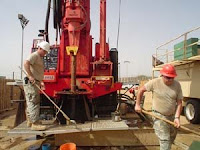 “The first drill site gave us confidence in ourselves and the equipment. It allowed us the time to learn how to manage the drill site with the new equipment and work on things we can do better,” said U.S. Army Staff Sgt. William Brown.
Recently, the 1132nd received word to install an additional water well to support Camp Lemonier’s future water supply needs. The first team of well drillers began prepping the site by digging a six-foot deep hole, emplacing a drill bit casing and stabilizing the hole with concrete to prevent the walls from collapsing during drilling operations.
“Setting-up our equipment at the drill site early is key to our efficiency as a team. During these last two drill sites we are constantly learning the pros and cons of the new drilling rig. I look forward to our missions in the future that will take us deeper into the vast regions of Djibouti,” said U.S. Army Staff Sgt. Rex Hipp.
Once the main drill site preparations were complete, the new drill rig and support vehicles were placed and drilling began. In short order a well was located at a depth of 128 ft. The well is expected to provide 400 gallons of water per minute. More than enough to meet the camp needs.
According to U.S. Navy Lt. j.g. Joseph Dunaway, “When we receive our additional water tanks, our water holding capacity will increase to 600,000 gallons. These numbers will enable us to increase our water management and efficiency on Camp Lemonier.”
Upon completion of the second Camp Lemonier water well, the 1132nd will have earned a short rest before beginning drilling operations for new water wells in the southern region of Djibouti. The luxury of having a well in the desert is a valuable resource to the people. The 1132nd will continue to drill water wells for the people of Djibouti anywhere they are needed.
Photo - Members of the 1132nd Engineer Team from North Carolina completes the final depth needed for the water well to ensure a useful water source. From left to right: U.S. Army Staff Sgt. William Brown, U.S. Army Sgt. First Class Danny Hunter, and U.S. Army Sgt. Raphael Paniaqua. Photo by U.S. Army Capt. Jerord E. Wilson.
Source: The Thunder Run.
This one reminds me of humanitarian acts, but it is also a very important mission they are doing. Not only are they digging wells for water for the people there and themselves, but they are in the Horn of Africa (HOA). What is so important about the HOA?
I'm glad you asked. Do you remember the war between Ethiopia and Somalia? That is also located in the Horn of Africa. So is al Qaida. Connect the dots...
This was originally posted @ DoD Daily News-2.
19-Jun-07
Story by U.S. Army Capt. Jerord E. Wilson
CJTF-HOA19-Jun-07.
CAMP LEMONIER, Djibouti – In preparation for the increase in personnel arriving to Camp Lemonier, the 1132nd Well Drillers of the North Carolina National Guard are hard at work improving the amount of water available for camp operations.
Within the last month, the 1132nd Well Drillers received a new well drilling rig capable of drilling through the toughest rock formations in Djibouti. The unit wasted no time in learning the intricate details of the new equipment and how to place it effectively into operation. Prior to this drilling event, they conducted a test to ensure the drilling equipment is fully operational before starting any job.
 “The first drill site gave us confidence in ourselves and the equipment. It allowed us the time to learn how to manage the drill site with the new equipment and work on things we can do better,” said U.S. Army Staff Sgt. William Brown.
Recently, the 1132nd received word to install an additional water well to support Camp Lemonier’s future water supply needs. The first team of well drillers began prepping the site by digging a six-foot deep hole, emplacing a drill bit casing and stabilizing the hole with concrete to prevent the walls from collapsing during drilling operations.
“Setting-up our equipment at the drill site early is key to our efficiency as a team. During these last two drill sites we are constantly learning the pros and cons of the new drilling rig. I look forward to our missions in the future that will take us deeper into the vast regions of Djibouti,” said U.S. Army Staff Sgt. Rex Hipp.
Once the main drill site preparations were complete, the new drill rig and support vehicles were placed and drilling began. In short order a well was located at a depth of 128 ft. The well is expected to provide 400 gallons of water per minute. More than enough to meet the camp needs.
According to U.S. Navy Lt. j.g. Joseph Dunaway, “When we receive our additional water tanks, our water holding capacity will increase to 600,000 gallons. These numbers will enable us to increase our water management and efficiency on Camp Lemonier.”
Upon completion of the second Camp Lemonier water well, the 1132nd will have earned a short rest before beginning drilling operations for new water wells in the southern region of Djibouti. The luxury of having a well in the desert is a valuable resource to the people. The 1132nd will continue to drill water wells for the people of Djibouti anywhere they are needed.
Photo - Members of the 1132nd Engineer Team from North Carolina completes the final depth needed for the water well to ensure a useful water source. From left to right: U.S. Army Staff Sgt. William Brown, U.S. Army Sgt. First Class Danny Hunter, and U.S. Army Sgt. Raphael Paniaqua. Photo by U.S. Army Capt. Jerord E. Wilson.
Source: The Thunder Run.
This one reminds me of humanitarian acts, but it is also a very important mission they are doing. Not only are they digging wells for water for the people there and themselves, but they are in the Horn of Africa (HOA). What is so important about the HOA?
I'm glad you asked. Do you remember the war between Ethiopia and Somalia? That is also located in the Horn of Africa. So is al Qaida. Connect the dots...
This was originally posted @ DoD Daily News-2.
Sunday, June 17, 2007
Happy Father's Day!
To all the men who've taken their job seriously, God bless you. I pray you have a very Happy Father's Day. For all the men who have been prevented from that great gift, either by the woman not allowing you to a Father or abortion, my heart still goes to you. I just wish you would have tried harder.
I can hear the outcries! Check yourself. Was it because you tired of trying? Did you think it would be better for your child? YOU WERE WRONG! But we all make mistakes. I should know! Happy Sperm Donor's Day to you.
If you have not been a Father to your children, you do not receive the mantle of Father. Not in my book.
To the men who stood up to the plate, you are the true heroes to your children. Now you have to check deep in your heart to find out whether or not you have been influenced by societal restraints or led your children in the ways of the Lord? Teaching your children that there is right and wrong and what the differences are. (You can do this whether you have a religion or not.)
I pray for all men today, that they are appreciated all year long and not just on this day. I pray all men would step up to the plate and be the men they are supposed to be. I pray, also, that the men of today would remember the Lord.
For those of you who do not like my prayers, DO NOT READ MY SITE! It's that simple. I'm a Christian woman, and we are lacking Christian men. Oh, there are many men out there, but they have lost their way. Womens' Lib, political correctness, women lieing, courts believing all women and no men, etc. These men have been attacked and beaten down. They need someone to stand up with them not for them.
Women, love your husband. Husbands, love your wife. Period. God bless you all.
I can hear the outcries! Check yourself. Was it because you tired of trying? Did you think it would be better for your child? YOU WERE WRONG! But we all make mistakes. I should know! Happy Sperm Donor's Day to you.
If you have not been a Father to your children, you do not receive the mantle of Father. Not in my book.
To the men who stood up to the plate, you are the true heroes to your children. Now you have to check deep in your heart to find out whether or not you have been influenced by societal restraints or led your children in the ways of the Lord? Teaching your children that there is right and wrong and what the differences are. (You can do this whether you have a religion or not.)
I pray for all men today, that they are appreciated all year long and not just on this day. I pray all men would step up to the plate and be the men they are supposed to be. I pray, also, that the men of today would remember the Lord.
For those of you who do not like my prayers, DO NOT READ MY SITE! It's that simple. I'm a Christian woman, and we are lacking Christian men. Oh, there are many men out there, but they have lost their way. Womens' Lib, political correctness, women lieing, courts believing all women and no men, etc. These men have been attacked and beaten down. They need someone to stand up with them not for them.
Women, love your husband. Husbands, love your wife. Period. God bless you all.
Daily Quote 6/11-15/2007
Labels:
daily quote
Mon. June 11, 2007.
"Justice is the end of government. It is the end of civil society. It ever has been and ever will be pursued until it be obtained, or until liberty be lost in the pursuit."
--James Madison (Federalist No. 51, 8 February 1788); Reference: Madison, Federalist No. 51.
Tue. 6/12/07.
"The apportionment of taxes on the various descriptions of property is an act which seems to require the most exact impartiality; yet there is, perhaps, no legislative act in which greater opportunity and temptation are given to a predominant party to trample on the rules of justice. Every shilling which they overburden the inferior number is a shilling saved to their own pockets."
--James Madison (Federalist No. 10, 23 November 1787); Reference: Madison, Federalist No. 10.
HERE! HERE!
Wed. 6/13/07.
"I have lived, Sir, a long time; and the longer I live, the more convincing proofs I see of this Truth, that God governs in the Affairs of Men. And if a Sparrow cannot fall to the Ground without his Notice, is it probable that an Empire can rise without his Aid?"
--Benjamin Franklin (Motion for Prayers in the Constitutional Convention, 28 June 1787); Reference: Franklin: Collected Works, Lemay, ed. (1138).
You just don't know how much I would have liked to have been there...
Thu. 6/14/07.
"The name of American, which belongs to you, in your national capacity, must always exalt the just pride of Patriotism, more than any appellation derived from local discriminations."
--George Washington (Farewell Address, 1796); Reference: Inaugural Addresses of the Presidents of the United States.
He was wise before his time.
Fri. 6/15/07.
"The happiest moments of my life have been the few which I have past at home in the bosom of my family."
--Thomas Jefferson (letter to Francis Willis Jr., 18 April 1790).
Founders' Quote Daily is a service of The Patriot Post, the most widely read conservative journal on the Internet. If you would like to receive Founders Quote Daily, and this highly acclaimed Digest of news, policy and opinion delivered FREE by e-mail to your inbox, link to: Subscribe.
All of the Founders' quotes distributed by FQD have been thoroughly researched and authenticated by the Heritage Foundation. For a complete database of Founders' quotes on various topics, link to the Internet's most comprehensive resource page on our Founding documents Historical Documents and select Founders Quote Database.
"Justice is the end of government. It is the end of civil society. It ever has been and ever will be pursued until it be obtained, or until liberty be lost in the pursuit."
--James Madison (Federalist No. 51, 8 February 1788); Reference: Madison, Federalist No. 51.
Tue. 6/12/07.
"The apportionment of taxes on the various descriptions of property is an act which seems to require the most exact impartiality; yet there is, perhaps, no legislative act in which greater opportunity and temptation are given to a predominant party to trample on the rules of justice. Every shilling which they overburden the inferior number is a shilling saved to their own pockets."
--James Madison (Federalist No. 10, 23 November 1787); Reference: Madison, Federalist No. 10.
HERE! HERE!
Wed. 6/13/07.
"I have lived, Sir, a long time; and the longer I live, the more convincing proofs I see of this Truth, that God governs in the Affairs of Men. And if a Sparrow cannot fall to the Ground without his Notice, is it probable that an Empire can rise without his Aid?"
--Benjamin Franklin (Motion for Prayers in the Constitutional Convention, 28 June 1787); Reference: Franklin: Collected Works, Lemay, ed. (1138).
You just don't know how much I would have liked to have been there...
Thu. 6/14/07.
"The name of American, which belongs to you, in your national capacity, must always exalt the just pride of Patriotism, more than any appellation derived from local discriminations."
--George Washington (Farewell Address, 1796); Reference: Inaugural Addresses of the Presidents of the United States.
He was wise before his time.
Fri. 6/15/07.
"The happiest moments of my life have been the few which I have past at home in the bosom of my family."
--Thomas Jefferson (letter to Francis Willis Jr., 18 April 1790).
Founders' Quote Daily is a service of The Patriot Post, the most widely read conservative journal on the Internet. If you would like to receive Founders Quote Daily, and this highly acclaimed Digest of news, policy and opinion delivered FREE by e-mail to your inbox, link to: Subscribe.
All of the Founders' quotes distributed by FQD have been thoroughly researched and authenticated by the Heritage Foundation. For a complete database of Founders' quotes on various topics, link to the Internet's most comprehensive resource page on our Founding documents Historical Documents and select Founders Quote Database.
Saturday, June 16, 2007
1,000,000 American March
Labels:
illegal aliens,
Politics
Enough talk. Enough phone calls. The Senate, the House, and the president do not care whether we do not like this bill for amnesty or not. So what do we do?
We all get together, Americans who happen to be of Mexican, Asian, African, European, etc. descent, and march on the walls and halls of Washington. Let them know we WILL be heard, and they WILL listen. They do work for US, the American citizens. Not invaders. Not al Qaida. Not Hizbullah. Not Hamas. Not anyone except US citizens. After all, we are the only ones that are supposed be allowed to vote, as if that happens.
I've had it with all the name calling by Senators, Congressmen and the president, that does not have to live the way we, as American citizens, do. As a teen, I worked as a waitress. I tried to get a job out here in California, but I could not get hired. Why not? I don't (and will not) speak Spanish. It is not because I find the language offensive, I do not. I love the language. I even speak enough of it to get by. The problem is, and it's a big one for most Americans, that I don't want anyone telling me that I HAVE to do so.
If you do not desire me telling you about Jesus Christ, then do not force me to speak your language in my own country. Period. Anyone. And you say it is the Christians trying push our agenda down your throats? HA! When is the last bill you heard of that said, "You must be a Christian"??? You have not, because it was put into the constitution that you can believe in whatever you choose. So get out of my face.
I will stand up for what I believe, and you had better believe that! I have that right just as much as you do. Being a Christian does NOT exclude me from politics. No. Just the opposite. It calls me to be responsible enough to get informed, be involved, and don't be lazy.
You will take this land that was given to us by God Almighty, where we made a solemn oath to Him in the Mayflower Compact, over my dead body.
Getting back to the point at hand. We need to make these 536 people realize that we mean business. That we are serious. In the mean time, do not stop calling that toll free number (866) 340-9281. Let them hear you. Be polite. Be firm, and do not allow them to lie to you. Refute them with facts.
1,000,000 American March is a pipe dream, and I know it. But wouldn't it be sweet?
We all get together, Americans who happen to be of Mexican, Asian, African, European, etc. descent, and march on the walls and halls of Washington. Let them know we WILL be heard, and they WILL listen. They do work for US, the American citizens. Not invaders. Not al Qaida. Not Hizbullah. Not Hamas. Not anyone except US citizens. After all, we are the only ones that are supposed be allowed to vote, as if that happens.
I've had it with all the name calling by Senators, Congressmen and the president, that does not have to live the way we, as American citizens, do. As a teen, I worked as a waitress. I tried to get a job out here in California, but I could not get hired. Why not? I don't (and will not) speak Spanish. It is not because I find the language offensive, I do not. I love the language. I even speak enough of it to get by. The problem is, and it's a big one for most Americans, that I don't want anyone telling me that I HAVE to do so.
If you do not desire me telling you about Jesus Christ, then do not force me to speak your language in my own country. Period. Anyone. And you say it is the Christians trying push our agenda down your throats? HA! When is the last bill you heard of that said, "You must be a Christian"??? You have not, because it was put into the constitution that you can believe in whatever you choose. So get out of my face.
I will stand up for what I believe, and you had better believe that! I have that right just as much as you do. Being a Christian does NOT exclude me from politics. No. Just the opposite. It calls me to be responsible enough to get informed, be involved, and don't be lazy.
You will take this land that was given to us by God Almighty, where we made a solemn oath to Him in the Mayflower Compact, over my dead body.
Getting back to the point at hand. We need to make these 536 people realize that we mean business. That we are serious. In the mean time, do not stop calling that toll free number (866) 340-9281. Let them hear you. Be polite. Be firm, and do not allow them to lie to you. Refute them with facts.
1,000,000 American March is a pipe dream, and I know it. But wouldn't it be sweet?
Friday, June 15, 2007
Never Forget
Labels:
Remember
I have tried to the best of my inability to bring my image over here, but alas. It just is not going to happen. If anyone has any helpful suggestions, I'm sure they would be appreciated.
However, there is a link on the sidebar that says, "Never Forget." If you click it, you will see the item and codes to add it to your very own site. Please do, so that we never do forget that day nor why our men and women are fighting 'til this day. I can tell you this, it is not because they have nothing better to do...so show some respect. Remember them, remember them all.
However, there is a link on the sidebar that says, "Never Forget." If you click it, you will see the item and codes to add it to your very own site. Please do, so that we never do forget that day nor why our men and women are fighting 'til this day. I can tell you this, it is not because they have nothing better to do...so show some respect. Remember them, remember them all.
Wednesday, June 13, 2007
Oh my! Bos'un has an article worth reading!
Labels:
illegal aliens,
Politics,
wars,
weapons
One of my writers who has been with me from the start has captured this story Wednesday, June 6, 2007. What a day to release a story! If you are interested in NOT getting blown up, this is a must read. Thanks Bos'un (from over at Bosun's Sail Locker.) Have a great day.
British and American Troops help ANA in readiness
The Aghanistan National Army (ANA) are busy training and working towards the day when they may be able to defend Afghanistan on their own. It seems to be going well. The 205th Regional Security Assistance Command are quite capable and are making sure of this. They are making sure that the ANA has the supplies they need and that the British are teaching them the American ways to run an Army. I like this.
ANA continues to train, lead with support of Soldiers.
4-Jun-2007
Sgt. LeeAnn Lloyd
22nd Mobile Public Affairs Detachment.
CAMP TOMBSTONE, Afghanistan - Making sure the Afghan National Army is properly equipped with the logistics and supplies it needs to conduct operations throughout the country can be a difficult task, but a team from the 205th Regional Security Assistance Command is up to the challenge.
The 3rd Brigade Logistics Support Team here works day in and day out to make sure the ANA’s 3rd Kandak, 205th “Hero” Corps, is taken care of so those ANA troops can go out and take care of their own. The LST also serves as background support to British Operational Mentoring Liaison Team, whose direct mission is to teach and mentor ANA Soldiers about Western doctrine.
 “Essentially our mission is to provide the ANA [with] what they need supply wise, and to ensure the British are teaching them American doctrine,” Army Capt. Matthew Blackwelder, supply officer with the 3-205th said.
Blackwelder said the thought strikes many as odd: Why would British Soldiers teach American doctrine to the Afghan Army? The answer is simply that the War on Terrorism remains a multinational effort as Afghanistan moves toward a state of peace and prosperity.
“By and large, the British way of doing things is much like [ours]. Their standing operating procedures do not differ dramatically from ours, but the terminology is different … So sometimes you just have to cut through the different vernacular to get to where you’re going,” Blackwelder noted.
Maintaining doctrinal continuity is a vital part of providing solid mentorship to the ANA, according to Army Maj. Marc Daniels, the 3-205th operations officer.
“The ANA have subscribed to our doctrine. What that means is you can’t teach them one type of doctrine down here in the 205th, and then be able to go back up to the 207th or the 209th and teach those Soldiers different doctrine. We are trying to establish continuity across the board, so the ANA can function with any kandak (similar to U.S. company size) throughout the country and the same standards still apply, regardless of the location of the Soldier,” he said.
The willingness to learn, coupled with the tenacity of Afghan soldiers, never ceases to amaze Blackwelder.
“Tactically, they know how to fight, and they’re not afraid to fight. They are tough. They are very willing to go out and do what needs to get done,” Blackwelder said.
Daniels recalled a recent event when their 3-205 LST supply convoy was hit with an IED, and the ANA were right there to help move supplies out of the damaged vehicle. They also proved themselves during that event when an escalation of enemy forces in the area attacked with indirect fire. Daniels said the ANA dismounted their vehicles and charged into fields without hesitation. The ANA were successful in detaining eight insurgents that day, even after one of their own vehicles hit a mine and was disabled.
“The ANA, they reacted very well. They reacted exactly as they were supposed to in a situation like that,” he noted.
The knowledge that the ANA has of the terrain and local villages plays a vital part in ensuring the security of ISAF forces.
“This is their country, they know the ground. In fact, after that ambush, they ended up pointing things out that made me wish I had included them in the planning process. There are things I may have picked up on if I had one of them with me leading the convoy,” Daniels said.
One thing that seems evident to the LST is that the ANA has the ambition necessary to perform the missions that ensure the security of their people.
“When it comes to fighting and being warriors, these guys are all over it,” Daniels said.
LSTs throughout Afghanistan will continue to provide the support necessary for soldiers of the ANA to sustain operations, because they know that one day, the ANA will be able to handle it on their own. The Soldiers of the 3-205th LST have seen first-hand how the ANA is capable of fighting the good fight as their potential continues to shine through with every mission.
Photo - With the help of an interpreter convoy leaders discuss hand signals prior to a mission in Sangin Vallry, Helmand Province. Photo by Sgt. LeeAnn Lloyd.
Source: DoD Daily News-2. Have a great day, and to those of you who are serving, "THANK YOU, and God bless you!"
ANA continues to train, lead with support of Soldiers.
4-Jun-2007
Sgt. LeeAnn Lloyd
22nd Mobile Public Affairs Detachment.
CAMP TOMBSTONE, Afghanistan - Making sure the Afghan National Army is properly equipped with the logistics and supplies it needs to conduct operations throughout the country can be a difficult task, but a team from the 205th Regional Security Assistance Command is up to the challenge.
The 3rd Brigade Logistics Support Team here works day in and day out to make sure the ANA’s 3rd Kandak, 205th “Hero” Corps, is taken care of so those ANA troops can go out and take care of their own. The LST also serves as background support to British Operational Mentoring Liaison Team, whose direct mission is to teach and mentor ANA Soldiers about Western doctrine.
 “Essentially our mission is to provide the ANA [with] what they need supply wise, and to ensure the British are teaching them American doctrine,” Army Capt. Matthew Blackwelder, supply officer with the 3-205th said.
 Blackwelder said the thought strikes many as odd: Why would British Soldiers teach American doctrine to the Afghan Army? The answer is simply that the War on Terrorism remains a multinational effort as Afghanistan moves toward a state of peace and prosperity.
“By and large, the British way of doing things is much like [ours]. Their standing operating procedures do not differ dramatically from ours, but the terminology is different … So sometimes you just have to cut through the different vernacular to get to where you’re going,” Blackwelder noted.
Maintaining doctrinal continuity is a vital part of providing solid mentorship to the ANA, according to Army Maj. Marc Daniels, the 3-205th operations officer.
“The ANA have subscribed to our doctrine. What that means is you can’t teach them one type of doctrine down here in the 205th, and then be able to go back up to the 207th or the 209th and teach those Soldiers different doctrine. We are trying to establish continuity across the board, so the ANA can function with any kandak (similar to U.S. company size) throughout the country and the same standards still apply, regardless of the location of the Soldier,” he said.
The willingness to learn, coupled with the tenacity of Afghan soldiers, never ceases to amaze Blackwelder.
“Tactically, they know how to fight, and they’re not afraid to fight. They are tough. They are very willing to go out and do what needs to get done,” Blackwelder said.
Daniels recalled a recent event when their 3-205 LST supply convoy was hit with an IED, and the ANA were right there to help move supplies out of the damaged vehicle. They also proved themselves during that event when an escalation of enemy forces in the area attacked with indirect fire. Daniels said the ANA dismounted their vehicles and charged into fields without hesitation. The ANA were successful in detaining eight insurgents that day, even after one of their own vehicles hit a mine and was disabled.
“The ANA, they reacted very well. They reacted exactly as they were supposed to in a situation like that,” he noted.
The knowledge that the ANA has of the terrain and local villages plays a vital part in ensuring the security of ISAF forces.
“This is their country, they know the ground. In fact, after that ambush, they ended up pointing things out that made me wish I had included them in the planning process. There are things I may have picked up on if I had one of them with me leading the convoy,” Daniels said.
One thing that seems evident to the LST is that the ANA has the ambition necessary to perform the missions that ensure the security of their people.
“When it comes to fighting and being warriors, these guys are all over it,” Daniels said.
LSTs throughout Afghanistan will continue to provide the support necessary for soldiers of the ANA to sustain operations, because they know that one day, the ANA will be able to handle it on their own. The Soldiers of the 3-205th LST have seen first-hand how the ANA is capable of fighting the good fight as their potential continues to shine through with every mission.
Photo - With the help of an interpreter convoy leaders discuss hand signals prior to a mission in Sangin Vallry, Helmand Province. Photo by Sgt. LeeAnn Lloyd.
Source: DoD Daily News-2. Have a great day, and to those of you who are serving, "THANK YOU, and God bless you!"
Monday, June 11, 2007
Tactical air controller receives Silver Star for actions during firefight
Air Force Staff Sgt. Earl I. Covel.
 For a special-forces team in the heat of battle, air cover can be the difference between life and death. Staff Sgt. Covel was assigned in Iraq to work with an elite team of 8 Army special-forces soldiers and 10 “peshmerga” – indigenous Kurdish guerilla fighters. In June 2004, part of the team headed from its safe house in the city center back to base to re-supply. While they were gone, they received a call that an attack on the safe house had begun. Based on previous engagements, however, the team assumed it would be a quick skirmish – even though some intelligence had warned of a massive offensive that was in the works. By the time the team returned to the house, they realized they were under an extremely fierce attack – an attack that would last 36 hours and involve an estimated 200 insurgents.
As the tactical air controller, Covel quickly made his way to his battle positions on the roof of an adjacent building so he could locate the enemy positions and direct air support. Insurgents were ready, and accurately fired on him as he crossed the short open space. As he described it later, “It felt for a moment like I was in some sort of movie, running as the dirt kicked up around me.”
On the roof, he set up his radios, requested air support, and began the arduous task of identifying targets while under fire. As he was doing so, another soldier in his position laid down cover fire so that Covel could get a good look at the enemy’s set-up. The insurgents spotted the two and began firing a machine gun in their direction, hitting Covel’s partner in the ear. Another Soldier carried the injured soldier to safety, leaving Covel alone in what he described as his own “little corner of hell.”
But he wasn’t alone for long: A pair of Navy F-18 jets zoomed in low and let loose with a heavy stream of fire on the positions Covel had marked. They were followed by a steady stream of air cover throughout the fight. The battle carried on for 36 hours – and so Covel carried on for 36 hours, coordinating air attacks and using his weapon to defend himself and his team. When Covel ran out of equipment to mark targets, he radioed some Bradley fighting vehicles in the area, asked the gunners to begin shooting at a specific target, then told his air crew to look for the building or areas where the Bradleys were firing. That was their next target.
In all, the small team of Soldiers and peshmerga lost not a single man, yet are credited with killing more than 100 insurgents. The Army team recommended Covel for the Silver Star, and he received the award on May 11, 2007.
For a special-forces team in the heat of battle, air cover can be the difference between life and death. Staff Sgt. Covel was assigned in Iraq to work with an elite team of 8 Army special-forces soldiers and 10 “peshmerga” – indigenous Kurdish guerilla fighters. In June 2004, part of the team headed from its safe house in the city center back to base to re-supply. While they were gone, they received a call that an attack on the safe house had begun. Based on previous engagements, however, the team assumed it would be a quick skirmish – even though some intelligence had warned of a massive offensive that was in the works. By the time the team returned to the house, they realized they were under an extremely fierce attack – an attack that would last 36 hours and involve an estimated 200 insurgents.As the tactical air controller, Covel quickly made his way to his battle positions on the roof of an adjacent building so he could locate the enemy positions and direct air support. Insurgents were ready, and accurately fired on him as he crossed the short open space. As he described it later, “It felt for a moment like I was in some sort of movie, running as the dirt kicked up around me.”
On the roof, he set up his radios, requested air support, and began the arduous task of identifying targets while under fire. As he was doing so, another soldier in his position laid down cover fire so that Covel could get a good look at the enemy’s set-up. The insurgents spotted the two and began firing a machine gun in their direction, hitting Covel’s partner in the ear. Another Soldier carried the injured soldier to safety, leaving Covel alone in what he described as his own “little corner of hell.”
But he wasn’t alone for long: A pair of Navy F-18 jets zoomed in low and let loose with a heavy stream of fire on the positions Covel had marked. They were followed by a steady stream of air cover throughout the fight. The battle carried on for 36 hours – and so Covel carried on for 36 hours, coordinating air attacks and using his weapon to defend himself and his team. When Covel ran out of equipment to mark targets, he radioed some Bradley fighting vehicles in the area, asked the gunners to begin shooting at a specific target, then told his air crew to look for the building or areas where the Bradleys were firing. That was their next target.
In all, the small team of Soldiers and peshmerga lost not a single man, yet are credited with killing more than 100 insurgents. The Army team recommended Covel for the Silver Star, and he received the award on May 11, 2007.
Friday, June 8, 2007
Daily Quote 6/8/2007
Labels:
daily quote
Friday, June 8, 2007.
"But ambitious encroachments of the federal government, on the
authority of the State governments, would not excite the opposition
of a single State, or of a few States only. They would be signals
of general alarm... But what degree of madness could ever drive
the federal government to such an extremity."
--James Madison (Federalist No. 46, 29 January 1788); Reference: The Federalist.
"But ambitious encroachments of the federal government, on the
authority of the State governments, would not excite the opposition
of a single State, or of a few States only. They would be signals
of general alarm... But what degree of madness could ever drive
the federal government to such an extremity."
--James Madison (Federalist No. 46, 29 January 1788); Reference: The Federalist.
Thursday, June 7, 2007
82nd Airborne Goes “all the Way” During Operation Achilles
Labels:
Military
By Army Sgt. Tony J. Spain
22nd Mobile Public Affairs Detachment.
HELMAND PROVINCE, Afghanistan, June 7, 2007 - Sounds from roaring engines and spinning rotors from the British CH-47 Chinook pierce through the night as the aircraft carries paratroopers of the 1st Battalion, 508th Parachute Infantry Regiment, 82nd Airborne Division, on an air assault mission into the lower Sangin Valley near the Gereshk District.
Landing under the cover of darkness in southern Afghanistan’s Helmand province, the “heart of Taliban country,” the back ramp of the Chinook drops and paratroopers make their way off the helicopter to pull security duty. The Chinook begins to kick up dirt and debris as it roars off into the darkness, leaving the paratroopers in the poppy fields of the Sangin Valley.
This is the latest air assault mission for the 1/508th in a series of sub-operations under “Operation Achilles,” an operation ongoing since early March. Many of these paratroopers spent more than 40 days in the first and second sub-operations of Achilles, only to return to the battlefield after a six-day regrouping period.
 It is just another day for the elite group from the 82nd Airborne Division. The paratroopers have a rich history since World War II of living up to their “all the way” motto by doing whatever it takes to accomplish what their country asks of them.
These parachute troops are going into places that have not previously had a U.S. presence and they are met with heavy resistance at times, said Army Lt. Col. Brian Mennes, battalion commander, 1/508th. “It shows there is nothing they can’t handle with competence, and that is impressive,” he said.
Achilles was launched at the request of the Islamic Republic of Afghanistan government and is the largest coalition operation to date. It involves about 5,500 International Security Assistance Force soldiers, including 1,000 soldiers from the Afghan National Security Force and close to 1,000 paratroopers from Fort Bragg’s 82nd Airborne Division.
Nicknamed the “Red Devils,” the 1/508th continues to play a key roll in conducting the largest air assault missions of Operation Enduring Freedom in a region that has not seen military operations since the Soviet Union’s occupation in the 1980s. There have actually been three separate operations within Achilles, said Mennes.
The first mission was in the Ghorak valley and was pretty calm, he said, and except for some minor skirmishes Taliban fighters were virtually nowhere to be found. The second and third missions took place in the Sangin Valley, one in the Sangin district and this one near Gereshk. The Sangin Valley is one of the most productive poppy-growing regions in the world. That, coupled with its reputation as a Taliban stronghold, made conducting missions in the valley a true test for the paratroopers.
“The fighting in Sangin was a lot more intense,” said Spc. Jacob Allen, 3rd Platoon, Company A, 1/508th. “There was a lot more Taliban activity than what there was during the Ghorak mission,” he said.
In the Sangin district, paratroopers began their assault clearing buildings and ridding the area of Taliban. Then, after completing the mission, they helped the local Afghans communicate with the Afghanistan government and provide security. Much of the same was to be expected on the mission near Gereshk.
This mission near Gereshk is an ongoing effort in Achilles with the overall goal to disrupt Taliban operations in the Sangin valley by targeting the Taliban leadership, Mennes said. Unlike missions in Iraq and elsewhere in Afghanistan, the terrain does not allow the luxury of a humvee. Paratroopers must move on foot carrying all their gear as they advance forward through poppy fields, jumping irrigation canals and fighting the Taliban into the dawn.
Finally getting a chance to rest, these exhausted paratroopers made a command post out of an Afghan farmhouse. They set up guard positions around the perimeter and found a place to sleep on the rock-hard, uneven ground beneath them. “I applaud all the efforts of these guys. They have to live under fairly austere conditions when they come out here. There are no FOBs (forward operating bases), there’s no Internet, there’s no ice cream or dining facilities. So they have to suck it up a little bit,” said Mennes.
In the next couple of days, the regiment swept through the countryside with little resistance in search of weapon caches and the Taliban. There was a lot of enemy contact with the Taliban in the first couple days in both the Sangin district and this operation and then sporadic stuff after that, Mennes said. “We found in Sangin (District) multiple weapons caches. Everything from mortars, 107mm rockets, IED (improvised explosive device) making materials, explosives, small arms, heavy machine guns and ammunition.”
Paratroopers entered the second phase of the operation, focusing on winning hearts and minds. After most of the fighting died down, the paratroopers provided security and humanitarian assistance to the local populace. When a father showed up with his sick 11-month-old child at the paratrooper’s command post, Spc. Fred Rawcliffe, combat medic for the infantry regiment was there to provide aid.
“His dad told me he had been vomiting on and off for about a month, and he had diarrhea,” said Rawcliffe. “I just checked out some of the common causes for kids to be doing that, like ear infections, or possibly teething.” Rawcliffe also found out that they were still feeding the child dry milk and that he was not eating a lot of solid foods. “I told them he needs to be coming off the milk, especially if it is not his mom’s milk, and go to solid food. Also, make sure to keep him hydrated in case he is teething,” said Rawcliffe.
Events like these could win over support of the Afghan people and make it easier for the paratroopers to accomplish their overall mission. “This is part of phase two, reaching out, meeting and helping the locals,” said Sgt 1st Class John NeSmith, the platoon sergeant.
According to Mennes, the measure of success is not about body counts of enemy Taliban combatants, but rather giving the people of Afghanistan a sense of security in their government so they can bring in the Afghan National Security Forces for long-term security. “In this part of the operation, what we try to do is accomplish a network with Afghans and help them form a stable, peaceful, and prosperous Afghanistan,” Mennes said.
One of the main methods to do this is to host local shuras – village council meetings – to meet local elders and discuss problems and concerns in their local area. Mennes says the purpose of the shuras is to try and establish a contact between his paratroopers and the locals as well as between the locals and the Afghanistan government. “In Sangin we were really successful,” said Mennes. “We stood up the first couple of shuras and after that the Afghans started running their own.”
The regiment hosted three shuras for the locals and a medical engagement to help Afghans who need treatment. Operation Achilles continues in the Helmand province providing security for reconstruction and development objectives.
Photo - Spc. Ying Kit Tsui of 3rd Platoon, Company A, 1st Battalion, 508th Parachute Infantry Regiment, 82nd Airborne Division speaks to a local Afghan with the help of a translator in the Sagin Valley near Gereshk.
Source: DefendAmerica.mil.
22nd Mobile Public Affairs Detachment.
HELMAND PROVINCE, Afghanistan, June 7, 2007 - Sounds from roaring engines and spinning rotors from the British CH-47 Chinook pierce through the night as the aircraft carries paratroopers of the 1st Battalion, 508th Parachute Infantry Regiment, 82nd Airborne Division, on an air assault mission into the lower Sangin Valley near the Gereshk District.
Landing under the cover of darkness in southern Afghanistan’s Helmand province, the “heart of Taliban country,” the back ramp of the Chinook drops and paratroopers make their way off the helicopter to pull security duty. The Chinook begins to kick up dirt and debris as it roars off into the darkness, leaving the paratroopers in the poppy fields of the Sangin Valley.
This is the latest air assault mission for the 1/508th in a series of sub-operations under “Operation Achilles,” an operation ongoing since early March. Many of these paratroopers spent more than 40 days in the first and second sub-operations of Achilles, only to return to the battlefield after a six-day regrouping period.
It is just another day for the elite group from the 82nd Airborne Division. The paratroopers have a rich history since World War II of living up to their “all the way” motto by doing whatever it takes to accomplish what their country asks of them.These parachute troops are going into places that have not previously had a U.S. presence and they are met with heavy resistance at times, said Army Lt. Col. Brian Mennes, battalion commander, 1/508th. “It shows there is nothing they can’t handle with competence, and that is impressive,” he said.
Achilles was launched at the request of the Islamic Republic of Afghanistan government and is the largest coalition operation to date. It involves about 5,500 International Security Assistance Force soldiers, including 1,000 soldiers from the Afghan National Security Force and close to 1,000 paratroopers from Fort Bragg’s 82nd Airborne Division.
Nicknamed the “Red Devils,” the 1/508th continues to play a key roll in conducting the largest air assault missions of Operation Enduring Freedom in a region that has not seen military operations since the Soviet Union’s occupation in the 1980s. There have actually been three separate operations within Achilles, said Mennes.
The first mission was in the Ghorak valley and was pretty calm, he said, and except for some minor skirmishes Taliban fighters were virtually nowhere to be found. The second and third missions took place in the Sangin Valley, one in the Sangin district and this one near Gereshk. The Sangin Valley is one of the most productive poppy-growing regions in the world. That, coupled with its reputation as a Taliban stronghold, made conducting missions in the valley a true test for the paratroopers.
“The fighting in Sangin was a lot more intense,” said Spc. Jacob Allen, 3rd Platoon, Company A, 1/508th. “There was a lot more Taliban activity than what there was during the Ghorak mission,” he said.
In the Sangin district, paratroopers began their assault clearing buildings and ridding the area of Taliban. Then, after completing the mission, they helped the local Afghans communicate with the Afghanistan government and provide security. Much of the same was to be expected on the mission near Gereshk.
This mission near Gereshk is an ongoing effort in Achilles with the overall goal to disrupt Taliban operations in the Sangin valley by targeting the Taliban leadership, Mennes said. Unlike missions in Iraq and elsewhere in Afghanistan, the terrain does not allow the luxury of a humvee. Paratroopers must move on foot carrying all their gear as they advance forward through poppy fields, jumping irrigation canals and fighting the Taliban into the dawn.
Finally getting a chance to rest, these exhausted paratroopers made a command post out of an Afghan farmhouse. They set up guard positions around the perimeter and found a place to sleep on the rock-hard, uneven ground beneath them. “I applaud all the efforts of these guys. They have to live under fairly austere conditions when they come out here. There are no FOBs (forward operating bases), there’s no Internet, there’s no ice cream or dining facilities. So they have to suck it up a little bit,” said Mennes.
In the next couple of days, the regiment swept through the countryside with little resistance in search of weapon caches and the Taliban. There was a lot of enemy contact with the Taliban in the first couple days in both the Sangin district and this operation and then sporadic stuff after that, Mennes said. “We found in Sangin (District) multiple weapons caches. Everything from mortars, 107mm rockets, IED (improvised explosive device) making materials, explosives, small arms, heavy machine guns and ammunition.”
Paratroopers entered the second phase of the operation, focusing on winning hearts and minds. After most of the fighting died down, the paratroopers provided security and humanitarian assistance to the local populace. When a father showed up with his sick 11-month-old child at the paratrooper’s command post, Spc. Fred Rawcliffe, combat medic for the infantry regiment was there to provide aid.
“His dad told me he had been vomiting on and off for about a month, and he had diarrhea,” said Rawcliffe. “I just checked out some of the common causes for kids to be doing that, like ear infections, or possibly teething.” Rawcliffe also found out that they were still feeding the child dry milk and that he was not eating a lot of solid foods. “I told them he needs to be coming off the milk, especially if it is not his mom’s milk, and go to solid food. Also, make sure to keep him hydrated in case he is teething,” said Rawcliffe.
Events like these could win over support of the Afghan people and make it easier for the paratroopers to accomplish their overall mission. “This is part of phase two, reaching out, meeting and helping the locals,” said Sgt 1st Class John NeSmith, the platoon sergeant.
According to Mennes, the measure of success is not about body counts of enemy Taliban combatants, but rather giving the people of Afghanistan a sense of security in their government so they can bring in the Afghan National Security Forces for long-term security. “In this part of the operation, what we try to do is accomplish a network with Afghans and help them form a stable, peaceful, and prosperous Afghanistan,” Mennes said.
One of the main methods to do this is to host local shuras – village council meetings – to meet local elders and discuss problems and concerns in their local area. Mennes says the purpose of the shuras is to try and establish a contact between his paratroopers and the locals as well as between the locals and the Afghanistan government. “In Sangin we were really successful,” said Mennes. “We stood up the first couple of shuras and after that the Afghans started running their own.”
The regiment hosted three shuras for the locals and a medical engagement to help Afghans who need treatment. Operation Achilles continues in the Helmand province providing security for reconstruction and development objectives.
Photo - Spc. Ying Kit Tsui of 3rd Platoon, Company A, 1st Battalion, 508th Parachute Infantry Regiment, 82nd Airborne Division speaks to a local Afghan with the help of a translator in the Sagin Valley near Gereshk.
Source: DefendAmerica.mil.
Teamwork in Djibouti Gets Ships Underway
7-Jun-07
by U.S. Navy MC1 (Petty Officer) Mary Popejoy
Combined Joint Task Force-Horn Of Africe Public Affairs.
DJIBOUTI, Africa, June 7, 2007 - In a unified effort, members of Combined Joint Task Force’s 6th Provisional Security Company, Explosive Ordnance Disposal unit, K-9 team, the U.S. Embassy and the Djiboutian military successfully launched USNS Kanawah (T-AO 196) May 28.
The teamwork between the U.S. military and their Djiboutian counterparts is essential when preparing a ship for a secure underway.
 “If we don’t work together, it could cause the ship to be delayed, which in turn would delay replenishments at sea of other ships, which is why having things run smoothly is extremely important,” said U.S. Marine Master Sgt. Harry McBrien, 6th PSC operations chief.
McBrien went on to say that it’s truly a pleasure being able to work with his host nation counterparts.
“I really enjoy working with the Djiboutian military because they take great pride in making sure the ship, the pier and the Marines are safe from harm,” he said. “They are a great group of people and consummate professionals in every sense of the word.”
The friendship between the U.S. military and its host nation counterparts help make the crew of each ship feel as safe as if they were in their own backyard, McBrien explained.
“Our goal is to make them feel more secure here than anywhere else in the world, no matter what,” said McBrien. “We also want to know what our customers think about our service because their feedback is critical to our security success.”
The organizations involved with this particular underway are doing something right because the crew of the Kanawah had nothing but positive things to say about the service they were provided.
“The service has been exceptional,” said Master-at-Arms 2nd Class (SW/ESW) William Day, tactical supervisor for Team Three of Mobile Security Detachment, Bahrain. “The support here by far is the best we’ve received. I wish we could stay longer, but its time for us to move on and complete other missions,” he said. “We feel very safe here with the Marines and their equipment and the Djiboutian military as well.”
The captain of the Kanawah also had positive things to say about the personnel and coordination.
“The service has been excellent,” said Capt. David Gommo. “I am very impressed with the total coordination of all the various elements because everything flowed smoothly and it got us underway right on schedule.”
The compliments by the crew make those who come out in triple-degree heat to get the ship underway very proud to be a part of these missions.
The compliments make the job worth it, but for Senior Chief Operations Specialist (SW) Scott Gray, Camp Lemonier’s Operations leading chief petty officer it’s all about safety.
“As long as the ship gets underway safely, it’s a good day,” he said.
He went on to say that everything the embark team does is a work in progress because there’s always room to improve.
“We’re not perfect, but we’re close and I think that is the reason we’re paid such great compliments by our customers,” said Gray.
The U.S. military and the Djiboutian military continue to work together with perfection as their goal.
“We have great team work and everyone knows what each other is doing and that’s what makes us successful,” said Lt. Ahmed Daher Djama, senior officer in the Djiboutian Coast Guard and Navy. “I am very proud to work with my American friends when it comes to port security.”
Photo - U.S. Marine Sgt. Chris Ream and a fellow Marine stand watch in front of USNS Kanawah (T-AO 196) May 28 as part of the security measures in place while a ship is in port in Djibouti. U.S. Navy photo by Mass Communication Specialist 1st Class Mary Popejoy.
Source: CENTCOM's link is broken so I used DefendAmerica.mil's link.
by U.S. Navy MC1 (Petty Officer) Mary Popejoy
Combined Joint Task Force-Horn Of Africe Public Affairs.
DJIBOUTI, Africa, June 7, 2007 - In a unified effort, members of Combined Joint Task Force’s 6th Provisional Security Company, Explosive Ordnance Disposal unit, K-9 team, the U.S. Embassy and the Djiboutian military successfully launched USNS Kanawah (T-AO 196) May 28.
The teamwork between the U.S. military and their Djiboutian counterparts is essential when preparing a ship for a secure underway.
“If we don’t work together, it could cause the ship to be delayed, which in turn would delay replenishments at sea of other ships, which is why having things run smoothly is extremely important,” said U.S. Marine Master Sgt. Harry McBrien, 6th PSC operations chief. McBrien went on to say that it’s truly a pleasure being able to work with his host nation counterparts.
“I really enjoy working with the Djiboutian military because they take great pride in making sure the ship, the pier and the Marines are safe from harm,” he said. “They are a great group of people and consummate professionals in every sense of the word.”
The friendship between the U.S. military and its host nation counterparts help make the crew of each ship feel as safe as if they were in their own backyard, McBrien explained.
“Our goal is to make them feel more secure here than anywhere else in the world, no matter what,” said McBrien. “We also want to know what our customers think about our service because their feedback is critical to our security success.”
The organizations involved with this particular underway are doing something right because the crew of the Kanawah had nothing but positive things to say about the service they were provided.
“The service has been exceptional,” said Master-at-Arms 2nd Class (SW/ESW) William Day, tactical supervisor for Team Three of Mobile Security Detachment, Bahrain. “The support here by far is the best we’ve received. I wish we could stay longer, but its time for us to move on and complete other missions,” he said. “We feel very safe here with the Marines and their equipment and the Djiboutian military as well.”
The captain of the Kanawah also had positive things to say about the personnel and coordination.
“The service has been excellent,” said Capt. David Gommo. “I am very impressed with the total coordination of all the various elements because everything flowed smoothly and it got us underway right on schedule.”
The compliments by the crew make those who come out in triple-degree heat to get the ship underway very proud to be a part of these missions.
The compliments make the job worth it, but for Senior Chief Operations Specialist (SW) Scott Gray, Camp Lemonier’s Operations leading chief petty officer it’s all about safety.
“As long as the ship gets underway safely, it’s a good day,” he said.
He went on to say that everything the embark team does is a work in progress because there’s always room to improve.
“We’re not perfect, but we’re close and I think that is the reason we’re paid such great compliments by our customers,” said Gray.
The U.S. military and the Djiboutian military continue to work together with perfection as their goal.
“We have great team work and everyone knows what each other is doing and that’s what makes us successful,” said Lt. Ahmed Daher Djama, senior officer in the Djiboutian Coast Guard and Navy. “I am very proud to work with my American friends when it comes to port security.”
Photo - U.S. Marine Sgt. Chris Ream and a fellow Marine stand watch in front of USNS Kanawah (T-AO 196) May 28 as part of the security measures in place while a ship is in port in Djibouti. U.S. Navy photo by Mass Communication Specialist 1st Class Mary Popejoy.
Source: CENTCOM's link is broken so I used DefendAmerica.mil's link.
Misawa squadrons swap out Iraqi mission
Labels:
Military
7-Jun-07
by 1st Lt. Shannon Collins
332nd Air Expeditionary Wing Public Affairs.
BALAD AIR BASE, Iraq (AFPN) -- Two F-16 Fighting Falcons flying thousands of feet in the air track a pair of vehicles full of known al-Qaida insurgents on the ground. The vehicles stop at a location free of collateral damage, and command officials make a decision. The F-16s drop precision-guided munitions and destroy the vehicles.
It is another successful mission to improve the security situation so Iraqi people can make the choices and do the work necessary to build a secure, stable and self-governing nation.
 This is just one of the many successful missions one fighter squadron performed while deployed here from Misawa Air Base, Japan. Now, they're passing the torch as one unit redeploys back to Japan as its sister squadron from Misawa AB replaces them.
More than 260 pilots, maintainers and support Airmen from the 13th Fighter Squadron and 35th Aircraft Maintenance Squadron from Misawa AB arrived here May 29 and 30 to swap places with 14th FS Airmen as part of air expeditionary force 7 and 8.
The mission for these squadrons is suppression of enemy air defenses, wherein they protect other aircraft from surface-to-air missiles using high-speed anti-radiation missiles and conventional bombs. They protect themselves and friendly aircraft from enemy aircraft with advanced air-to-air radar and avionics systems.
Though the pilots maintain the capability to support that mission for U.S. Central Command officials at a moment's notice, they fly in the close-air-support role with advanced targeting pods.
"Both squadrons had to undergo a rigorous four- to five-month spin up program to be ready for the deployment," said Lt. Col. Charles Toplikar, the 14th Expeditionary Fighter Squadron commander. "Our success in the transition has been phenomenal."
Throughout the deployment for AEF 5 and 6, the 14th EFS Airmen flew about 1,400 sorties and about 5,800 hours throughout the area of responsibility. They employed ordnance against enemy forces 46 times and provided support to ground forces operations by "show of force" and non-traditional intelligence, surveillance and reconnaissance. Show of force can be dropping flares to let insurgents know fighter aircraft were nearby. These instances mainly aided ground forces when they were receiving small arms fire from insurgents.
Though the close-air-support mission is new to the squadron, being in Iraq isn't.
"We were the first non-stealth aircraft over Baghdad on day one of Operation Iraqi Freedom in the spring of 2003," Colonel Toplikar said.
The native of Cedar Rapids, Iowa, said he is proud of his Airmen and their role in the war on terrorism.
"Both my fighter squadron and the supporting aircraft maintenance units Airmen are very young, with less than 15 percent having ever deployed to a combat environment," he said. "We trained hard for more than four months, focusing on our new mission. Everyone, from the youngest Airman up, has risen to every challenge."
The 14th EFS' sister squadron, the 13th EFS, is ready for the upcoming challenge, said Lt Col. Steve Williams, the 13th EFS commander.
"We've been working hard to train for this challenge, and now it's time to put our training to the test," said the native of Midland, Mich. "Our team building has been ongoing for many months because a successful mission relies on Airmen from every career field -- weapons crews, avionic techs, fuels, life support, intelligence, controllers, maintainers and pilots.
"I'm confident our team will accomplish any (Combined Forces Air Component commander) tasking with success and professionalism," he said. "We're focused on the challenge and appreciate the opportunity to support our nation's calling and continue the tradition of the Tuskegee Airmen."
Photo - Lt. Col. Steve Williams inspects his F-16 Fighting Falcon before flying his first combat mission for air expeditionary force 7 and 8 May 30 from Balad Air Base, Iraq. Colonel Williams is the 13th Expeditionary Fighter Squadron commander. More than 260 Airmen from the 13th EFS and 35th Aircraft Maintenance Squadron from Misawa Air Base, Japan, took over the close-air-support mission from their sister squadron, the 14th Expeditionary Fighter Squadron. Photo by 1st Lt. Shannon Collins.
Source: CENTCOM link is broken, so I am using the Air Force link.
by 1st Lt. Shannon Collins
332nd Air Expeditionary Wing Public Affairs.
BALAD AIR BASE, Iraq (AFPN) -- Two F-16 Fighting Falcons flying thousands of feet in the air track a pair of vehicles full of known al-Qaida insurgents on the ground. The vehicles stop at a location free of collateral damage, and command officials make a decision. The F-16s drop precision-guided munitions and destroy the vehicles.
It is another successful mission to improve the security situation so Iraqi people can make the choices and do the work necessary to build a secure, stable and self-governing nation.
This is just one of the many successful missions one fighter squadron performed while deployed here from Misawa Air Base, Japan. Now, they're passing the torch as one unit redeploys back to Japan as its sister squadron from Misawa AB replaces them.More than 260 pilots, maintainers and support Airmen from the 13th Fighter Squadron and 35th Aircraft Maintenance Squadron from Misawa AB arrived here May 29 and 30 to swap places with 14th FS Airmen as part of air expeditionary force 7 and 8.
The mission for these squadrons is suppression of enemy air defenses, wherein they protect other aircraft from surface-to-air missiles using high-speed anti-radiation missiles and conventional bombs. They protect themselves and friendly aircraft from enemy aircraft with advanced air-to-air radar and avionics systems.
Though the pilots maintain the capability to support that mission for U.S. Central Command officials at a moment's notice, they fly in the close-air-support role with advanced targeting pods.
"Both squadrons had to undergo a rigorous four- to five-month spin up program to be ready for the deployment," said Lt. Col. Charles Toplikar, the 14th Expeditionary Fighter Squadron commander. "Our success in the transition has been phenomenal."
Throughout the deployment for AEF 5 and 6, the 14th EFS Airmen flew about 1,400 sorties and about 5,800 hours throughout the area of responsibility. They employed ordnance against enemy forces 46 times and provided support to ground forces operations by "show of force" and non-traditional intelligence, surveillance and reconnaissance. Show of force can be dropping flares to let insurgents know fighter aircraft were nearby. These instances mainly aided ground forces when they were receiving small arms fire from insurgents.
Though the close-air-support mission is new to the squadron, being in Iraq isn't.
"We were the first non-stealth aircraft over Baghdad on day one of Operation Iraqi Freedom in the spring of 2003," Colonel Toplikar said.
The native of Cedar Rapids, Iowa, said he is proud of his Airmen and their role in the war on terrorism.
"Both my fighter squadron and the supporting aircraft maintenance units Airmen are very young, with less than 15 percent having ever deployed to a combat environment," he said. "We trained hard for more than four months, focusing on our new mission. Everyone, from the youngest Airman up, has risen to every challenge."
The 14th EFS' sister squadron, the 13th EFS, is ready for the upcoming challenge, said Lt Col. Steve Williams, the 13th EFS commander.
"We've been working hard to train for this challenge, and now it's time to put our training to the test," said the native of Midland, Mich. "Our team building has been ongoing for many months because a successful mission relies on Airmen from every career field -- weapons crews, avionic techs, fuels, life support, intelligence, controllers, maintainers and pilots.
"I'm confident our team will accomplish any (Combined Forces Air Component commander) tasking with success and professionalism," he said. "We're focused on the challenge and appreciate the opportunity to support our nation's calling and continue the tradition of the Tuskegee Airmen."
Photo - Lt. Col. Steve Williams inspects his F-16 Fighting Falcon before flying his first combat mission for air expeditionary force 7 and 8 May 30 from Balad Air Base, Iraq. Colonel Williams is the 13th Expeditionary Fighter Squadron commander. More than 260 Airmen from the 13th EFS and 35th Aircraft Maintenance Squadron from Misawa Air Base, Japan, took over the close-air-support mission from their sister squadron, the 14th Expeditionary Fighter Squadron. Photo by 1st Lt. Shannon Collins.
Source: CENTCOM link is broken, so I am using the Air Force link.
Monday, May 21, 2007
From ODs to ACUs, Vietnam to OIF
Labels:
Military
7-Jun-07
By Spc. Stephanie Homan
MNC-I PAO.
BAGHDAD — “What were they called? BDUs? Yeah, I missed that entire era,” said Chief Warrant Officer George Grayhek, intelligence electronic warfare officer for 502nd Military Intelligence Battalion, 504th MI Brigade.
“My wife said I could have two years in the sandbox with the Soldiers and I want the two years,” he said, but he knew it would not be easy.
 Grayhek, a Washington state native, first served in the Army from 1959 to 1979, then retired as a chief warrant officer. He returned to duty in 2006.
“I am (part of a) very special group of people that recognizes the Army is undermanned and I wanted to do more than send a package or a card,” said the 65-year-old maintenance Soldier. “I had to help. I am financially stable, my kids are doing great, and my grandkids are doing great. I have the time. I am one of the few people (at my age) who is fortunate enough to be able to be here and I should be here.”
Sgt. 1st Class Verlon Land, intelligence electronic warfare foreman with 502nd MI Bn., works with Grayhek on a daily basis and has a lot of respect and admiration for the chief’s reunion with the Army.
“Chief fought so hard to get to come to Iraq,” Land said. “He just wanted to serve one more time. He brings a little bit of the ‘old’ Army back to us.”
Grayhek said there is a lot of prejudice when you are over 60 years old and that people make it seem like you have one foot in a geriatric clinic.
“People really hold age against you,” he said.
In July 2005 the Army had more than 3,300 retired Soldiers who applied and said they would come back to the Army if they were needed, Grayhek said.
“Some people count each day until they can get out of the uniform. I count every day until I have to get out of the uniform,” he said. “We want to give the battlefield commander 100 percent strength if we can do it.”
Grayhek traveled to two other states outside his own to find someone who would endorse him for active duty. He believes the Army is to thank for a big majority of his success in life.
"I wasn’t sure I wanted to go to college (in 1959),” he said. “The Army is my Alma Mater. They trained me, invested in me, gave me a security clearance and a sense of purpose. I took all that (in 1979) when I got out and went to work. I had no trouble finding a job anywhere I (went).”
Land said that Grayhek goes out of his way to work with the Soldiers on missions. The Soldiers reinforce the reason he returned to duty.
“I like to go with the Soldiers rather than just telling them to go take care of it. That’s the fun of it,” Grayhek said.
He said he prefers to be out in the field with fellow Soldiers.
“I’ve always been a field Soldier, and I wanted to come to Iraq because I have never been here. It is fantastic to see these Soldiers and work with them. I have to be here. When I look at the machine I work on, and when I look at the Soldiers, it reinforces that.”
Photo - Chief Warrant Officer George Grayhek, Intelligence Electronic Warfare officer with the 502nd Military Intelligence Battalion, 504th MI Brigade, helps serve dinner to Soldiers at Camp Slayer during his tour in Operation Iraqi Freedom. Photo courtesy of 502nd MI Bn.
By Spc. Stephanie Homan
MNC-I PAO.
BAGHDAD — “What were they called? BDUs? Yeah, I missed that entire era,” said Chief Warrant Officer George Grayhek, intelligence electronic warfare officer for 502nd Military Intelligence Battalion, 504th MI Brigade.
“My wife said I could have two years in the sandbox with the Soldiers and I want the two years,” he said, but he knew it would not be easy.
Grayhek, a Washington state native, first served in the Army from 1959 to 1979, then retired as a chief warrant officer. He returned to duty in 2006.“I am (part of a) very special group of people that recognizes the Army is undermanned and I wanted to do more than send a package or a card,” said the 65-year-old maintenance Soldier. “I had to help. I am financially stable, my kids are doing great, and my grandkids are doing great. I have the time. I am one of the few people (at my age) who is fortunate enough to be able to be here and I should be here.”
Sgt. 1st Class Verlon Land, intelligence electronic warfare foreman with 502nd MI Bn., works with Grayhek on a daily basis and has a lot of respect and admiration for the chief’s reunion with the Army.
“Chief fought so hard to get to come to Iraq,” Land said. “He just wanted to serve one more time. He brings a little bit of the ‘old’ Army back to us.”
Grayhek said there is a lot of prejudice when you are over 60 years old and that people make it seem like you have one foot in a geriatric clinic.
“People really hold age against you,” he said.
In July 2005 the Army had more than 3,300 retired Soldiers who applied and said they would come back to the Army if they were needed, Grayhek said.
“Some people count each day until they can get out of the uniform. I count every day until I have to get out of the uniform,” he said. “We want to give the battlefield commander 100 percent strength if we can do it.”
Grayhek traveled to two other states outside his own to find someone who would endorse him for active duty. He believes the Army is to thank for a big majority of his success in life.
"I wasn’t sure I wanted to go to college (in 1959),” he said. “The Army is my Alma Mater. They trained me, invested in me, gave me a security clearance and a sense of purpose. I took all that (in 1979) when I got out and went to work. I had no trouble finding a job anywhere I (went).”
Land said that Grayhek goes out of his way to work with the Soldiers on missions. The Soldiers reinforce the reason he returned to duty.
“I like to go with the Soldiers rather than just telling them to go take care of it. That’s the fun of it,” Grayhek said.
He said he prefers to be out in the field with fellow Soldiers.
“I’ve always been a field Soldier, and I wanted to come to Iraq because I have never been here. It is fantastic to see these Soldiers and work with them. I have to be here. When I look at the machine I work on, and when I look at the Soldiers, it reinforces that.”
Photo - Chief Warrant Officer George Grayhek, Intelligence Electronic Warfare officer with the 502nd Military Intelligence Battalion, 504th MI Brigade, helps serve dinner to Soldiers at Camp Slayer during his tour in Operation Iraqi Freedom. Photo courtesy of 502nd MI Bn.
Tuesday, February 27, 2007
Cheney safe after blast at Afghan base kills 23
BAGRAM, Afghanistan (AP) — A suicide bomber attacked the entrance to the main U.S. military base in Afghanistan on Tuesday during a visit by Vice President Dick Cheney, killing up to 23 people and wounding 20.
Cheney was unhurt in the attack, which was claimed by the Taliban and was the closest that militants have come to a top U.S. official visiting Afghanistan. At least one U.S. soldier, an American contractor and a South Korean soldier were among the dead, NATO said.
ON DEADLINE: Was it an assassination attempt?
VIDEO: Taliban says it was.
Cheney, who visited with President Hamid Karzai and then left the country two hours after the blast, said the attackers were trying "to find ways to question the authority of the central government."
The vice president had spent the night at the sprawling Bagram Air Base, and it was about 10 a.m. when the explosion sent up a plume of smoke visible by reporters accompanying. U.S. military officials declared a "red alert."
"I heard a loud boom," Cheney told reporters. "The Secret Service came in and told me there had been an attack on the main gate."
He said he was moved "for a brief period of time" to one of the base bomb shelters near his quarters. "As the situation settled down and they had a better sense of what was going on, I went back to my room," Cheney added.
Asked if the Taliban were trying to send a message with the attack, Cheney said that fighters "clearly try to find ways to question the authority of the central government."
"Striking at the Bagram (base) with a suicide bomber, I suppose, is one way to do that," he said. "It shouldn't affect our behavior."
Maj. William Mitchell said it did not appear the explosion was intended as a threat to Cheney. "He wasn't near the site of the explosion," Mitchell said. "He was safely within the base at the time of the explosion."
There were conflicting reports on the death toll. Karzai's office said 23 people were killed, including 20 Afghan workers at the base. Another 20 people were injured, it said.
Source: USA Today.
May you walk with the LORD always, and when you cannot take another step, may He carry you the rest of the way until you can walk along side Him again.
Cross-posted @ Rosemary's Thoughts.
Cheney was unhurt in the attack, which was claimed by the Taliban and was the closest that militants have come to a top U.S. official visiting Afghanistan. At least one U.S. soldier, an American contractor and a South Korean soldier were among the dead, NATO said.
ON DEADLINE: Was it an assassination attempt?
VIDEO: Taliban says it was.
Cheney, who visited with President Hamid Karzai and then left the country two hours after the blast, said the attackers were trying "to find ways to question the authority of the central government."
The vice president had spent the night at the sprawling Bagram Air Base, and it was about 10 a.m. when the explosion sent up a plume of smoke visible by reporters accompanying. U.S. military officials declared a "red alert."
"I heard a loud boom," Cheney told reporters. "The Secret Service came in and told me there had been an attack on the main gate."
He said he was moved "for a brief period of time" to one of the base bomb shelters near his quarters. "As the situation settled down and they had a better sense of what was going on, I went back to my room," Cheney added.
Asked if the Taliban were trying to send a message with the attack, Cheney said that fighters "clearly try to find ways to question the authority of the central government."
"Striking at the Bagram (base) with a suicide bomber, I suppose, is one way to do that," he said. "It shouldn't affect our behavior."
Maj. William Mitchell said it did not appear the explosion was intended as a threat to Cheney. "He wasn't near the site of the explosion," Mitchell said. "He was safely within the base at the time of the explosion."
There were conflicting reports on the death toll. Karzai's office said 23 people were killed, including 20 Afghan workers at the base. Another 20 people were injured, it said.
Source: USA Today.
May you walk with the LORD always, and when you cannot take another step, may He carry you the rest of the way until you can walk along side Him again.
Cross-posted @ Rosemary's Thoughts.
Saturday, February 24, 2007
CIA files: Japanese war leaders spied in Cold War
Labels:
Asia,
war crimes,
wars
TOKYO, Japan (AP) -- Col. Masanobu Tsuji was a fanatical Japanese militarist and brutal warrior, hunted after World War II for massacres of Chinese civilians and complicity in the Bataan Death March.
And then he became a U.S. spy.
Newly declassified CIA records, released by the U.S. National Archives and examined by The Associated Press, document more fully than ever how Tsuji and other suspected Japanese war criminals were recruited by U.S. intelligence in the early days of the Cold War.
The documents also show how ineffective the effort was, in the CIA's view.
The records, declassified in 2005 and 2006 under an act of Congress in tandem with Nazi war crime-related files, fill in many of the blanks in the previously spotty documentation of the occupation authority's intelligence arm and its involvement with Japanese ultra-nationalists and war criminals, historians say.
In addition to Tsuji, who escaped Allied prosecution and was elected to parliament in the 1950s, conspicuous figures in U.S.-funded operations included mob boss and war profiteer Yoshio Kodama, and Takushiro Hattori, former private secretary to Hideki Tojo, the wartime prime minister hanged as a war criminal in 1948.
The CIA also cast a harsh eye on its counterparts -- and institutional rivals -- at G-2, the occupation's intelligence arm, providing evidence for the first time that the Japanese operatives often bilked gullible American patrons, passing on useless intelligence and using their U.S. ties to boost smuggling operations and further their efforts to resurrect a militarist Japan.
The assessments in the files are far from uniform. They show evidence that other U.S. agencies, such as the Air Force, were also looking into using some of the same people as spies, and that the CIA itself had contacts with former Japanese war criminals. Some CIA reports gave passing grades to the G-2 contacts' intelligence potential.
But on balance, the reports were negative, and historians say there is scant documentary evidence from occupation authorities to contradict the CIA assessment.
The files, hundreds of pages of which were obtained last month by the AP, depict operations that were deeply flawed by agents' lack of expertise, rivalries and shifting alliances between competing groups, and Japanese operatives' overriding interest in right-wing activities and money rather than U.S. security aims.
"Frequently they resorted to padding or outright fabrication of information for the purposes of prestige or profit," a 1951 CIA assessment said of the agents. "The postwar era in Japan ... produced a phenomenal increase in the number of these worthless information brokers, intelligence informants and agents."
The contacts in Japan mirror similar efforts in postwar Germany by the Americans to glean intelligence on the Soviet Union from ex-Nazis. But historians say a major contrast is the ineffectiveness of the Japanese operations.
The main aims were to spy on Communists inside Japan, place agents in Soviet and North Korean territory, and use Japanese mercenaries to bolster Taiwanese defenses against the triumphant Communist forces in mainland China.
Some of the missions detailed by the CIA papers, however, bordered on the comical.
The Americans, for instance, provided money for a boat to infiltrate Japanese agents into the Soviet island of Sakhalin -- but the money, boat and agents apparently disappeared, one report said. In Taiwan, the Japanese traded recruits for shiploads of bananas to sell on the black market back home.
The operatives also were suspected of having murky links with the Communists they were assigned to undermine, the documents say. The CIA also said some agents sold the same information to different U.S. contacts, increasing their earnings, and funneled information on the American military back into the Japanese nationalist underground.
The files and historians strongly suggest that American lack of knowledge about Japan or interest in war crimes committed in Asia, and a reliance on operatives' own assessment of their intelligence skills, made U.S. officials, in the words of one CIA report, "easy to fool for a time."
"This was a bunch of Japanese nationalists taking the G-2 for a ride," said Carol Gluck, a specialist in Japanese history at Columbia University and adviser to the archives working group administering declassification of the papers. "One thing that was interesting was how absolutely nonsensical it was, of no use to anybody but the people involved. Almost funny in a way."
The informants, many of whom were held as war criminals after Tokyo's surrender and subsequently released, operated under the patronage of Maj. Gen. Charles Willoughby, a German-born, monocle-wearing admirer of Mussolini, a staunch anti-Communist and, as the chief of G-2 in the occupation government, considered second in power only to his boss, Gen. Douglas MacArthur.
Some of Willoughby's proteges were seen as prime war trial material by Allied prosecutors.
But even as the occupation authorities were recrafting Japan into a democracy, their focus was shifting to containing the Soviets. Willoughby saw the military men as key to making Japan an anti-Communist bulwark in Asia -- and ensuring that Tokyo would rapidly rearm, this time as a U.S. ally.
Historians long ago concluded that the Allies turned a blind eye to many Japanese war crimes, particularly those committed against other Asians, as fighting communism became the West's priority.
Chief among the Japanese operatives was Seizo Arisue, Japan's intelligence chief at the end of the war. Arisue had been a key figure in the pro-war camp and in forging Japan's alliance with Nazi Germany and Fascist Italy in the 1930s.
According to the files, Arisue was soon ensconced in G-2, working with former Lt. Gen. Yorashiro Kawabe, who was a military intelligence officer in China in 1938 -- to organize groups of veterans and others for underground operations.
These groups consisted of former war buddies and often retained the same chains of command and militarist ideology of the war machine that ground much of Asia into submission in the 1930s and '40s.
"It shows how we acquiesced to the Japanese ... in order to continue to build up Japan as our ally," said Linda Goetz Holmes, author of "Unjust Enrichment: How Japan's Companies Built Postwar Fortunes Using American POWs."
"The whole thing was Cold War fear and an awful lot of postwar compensation issues ... all of that was subservient to our total fear of Russia," said Holmes, also a historical adviser for the declassification project.
Indeed, that new focus brought some of Japan's most notorious wartime killers under U.S. sponsorship.
Tsuji, for instance, was wanted for involvement in the Bataan Death March of early 1942, in which thousands of Americans and Filipinos perished, and for allegedly co-signing an order to massacre anti-Japanese Chinese merchants in Malaya.
Yet none of that seemed to matter much to American intelligence. The U.S. Air Force attempted unsuccessfully to recruit him after he was taken off the war crimes list in 1949 and came out of hiding, and CIA and U.S. Army files show him working for G-2. In the 1950s he was elected to Japan's parliament. He vanished in Laos in 1961 and was never seen again.
The Army considered him a potentially valuable source, but the CIA was not impressed with Tsuji's skills as an agent. The files show he was far more concerned with furthering various right-wing causes and basking in publicity generated by controversial political statements.
"In either politics or intelligence work, he is hopelessly lost both by reason of personality and lack of experience," said a CIA assessment from 1954. Another 1954 file says: "Tsuji is the type of man who, given the chance, would start World War III without any misgivings."
Kodama was another unsavory player. A virulent anti-communist and superbly connected smuggler and political fixer, Kodama commanded a vast network of black marketeers and former Japanese secret police agents in East Asia.
The CIA, however, concluded he was much more concerned about making money than furthering U.S. interests. A gangland boss, he later played a major role in the Lockheed Scandal, one of the country's biggest post-World War II bribery cases. He died in 1984.
"Kodama Yoshio's value as an intelligence operative is virtually nil," says a particularly harsh 1953 CIA report. "He is a professional liar, gangster, charlatan and outright thief... Kodama is completely incapable of intelligence operations, and has no interest in anything but the profits."
Nowadays, the most powerful legacy of the U.S. occupation is the democratic freedoms and pacifism built into Japan's 1947 constitution. But the U.S. association with Japanese war criminals illustrates how Washington embraced nationalist and conservative forces after World War II, helping them reassert their grip on the government once the occupation ended in 1952.
"Its hard to imagine back in those days how intent the U.S. was on rapid remilitarization of Japan," said John Dower, historian and author of "Embracing Defeat: Japan in the Wake of World War II."
"When we talk about the emergence of neo-nationalism or a strong right wing in Japan today, this has very deep roots and it involves a very strong element of American support," he said.
Yet the ex-war criminals failed to rebuild a militarist Japan. "Prewar right-wing activists who escaped war crime charges in fact did not have much influence in the postwar period," said Eiji Takemae, historian and author of The Allied Occupation of Japan.
To the Americans, he said, "they were in fact not very useful."
Source: CNN.
May you walk with the LORD always, and when you cannot take another step, may He carry you the rest of the way until you can walk along side Him again.
Cross-posted @ Rosemary's News and Ideas.
And then he became a U.S. spy.
Newly declassified CIA records, released by the U.S. National Archives and examined by The Associated Press, document more fully than ever how Tsuji and other suspected Japanese war criminals were recruited by U.S. intelligence in the early days of the Cold War.
The documents also show how ineffective the effort was, in the CIA's view.
The records, declassified in 2005 and 2006 under an act of Congress in tandem with Nazi war crime-related files, fill in many of the blanks in the previously spotty documentation of the occupation authority's intelligence arm and its involvement with Japanese ultra-nationalists and war criminals, historians say.
In addition to Tsuji, who escaped Allied prosecution and was elected to parliament in the 1950s, conspicuous figures in U.S.-funded operations included mob boss and war profiteer Yoshio Kodama, and Takushiro Hattori, former private secretary to Hideki Tojo, the wartime prime minister hanged as a war criminal in 1948.
The CIA also cast a harsh eye on its counterparts -- and institutional rivals -- at G-2, the occupation's intelligence arm, providing evidence for the first time that the Japanese operatives often bilked gullible American patrons, passing on useless intelligence and using their U.S. ties to boost smuggling operations and further their efforts to resurrect a militarist Japan.
The assessments in the files are far from uniform. They show evidence that other U.S. agencies, such as the Air Force, were also looking into using some of the same people as spies, and that the CIA itself had contacts with former Japanese war criminals. Some CIA reports gave passing grades to the G-2 contacts' intelligence potential.
But on balance, the reports were negative, and historians say there is scant documentary evidence from occupation authorities to contradict the CIA assessment.
The files, hundreds of pages of which were obtained last month by the AP, depict operations that were deeply flawed by agents' lack of expertise, rivalries and shifting alliances between competing groups, and Japanese operatives' overriding interest in right-wing activities and money rather than U.S. security aims.
"Frequently they resorted to padding or outright fabrication of information for the purposes of prestige or profit," a 1951 CIA assessment said of the agents. "The postwar era in Japan ... produced a phenomenal increase in the number of these worthless information brokers, intelligence informants and agents."
The contacts in Japan mirror similar efforts in postwar Germany by the Americans to glean intelligence on the Soviet Union from ex-Nazis. But historians say a major contrast is the ineffectiveness of the Japanese operations.
The main aims were to spy on Communists inside Japan, place agents in Soviet and North Korean territory, and use Japanese mercenaries to bolster Taiwanese defenses against the triumphant Communist forces in mainland China.
Some of the missions detailed by the CIA papers, however, bordered on the comical.
The Americans, for instance, provided money for a boat to infiltrate Japanese agents into the Soviet island of Sakhalin -- but the money, boat and agents apparently disappeared, one report said. In Taiwan, the Japanese traded recruits for shiploads of bananas to sell on the black market back home.
The operatives also were suspected of having murky links with the Communists they were assigned to undermine, the documents say. The CIA also said some agents sold the same information to different U.S. contacts, increasing their earnings, and funneled information on the American military back into the Japanese nationalist underground.
The files and historians strongly suggest that American lack of knowledge about Japan or interest in war crimes committed in Asia, and a reliance on operatives' own assessment of their intelligence skills, made U.S. officials, in the words of one CIA report, "easy to fool for a time."
"This was a bunch of Japanese nationalists taking the G-2 for a ride," said Carol Gluck, a specialist in Japanese history at Columbia University and adviser to the archives working group administering declassification of the papers. "One thing that was interesting was how absolutely nonsensical it was, of no use to anybody but the people involved. Almost funny in a way."
The informants, many of whom were held as war criminals after Tokyo's surrender and subsequently released, operated under the patronage of Maj. Gen. Charles Willoughby, a German-born, monocle-wearing admirer of Mussolini, a staunch anti-Communist and, as the chief of G-2 in the occupation government, considered second in power only to his boss, Gen. Douglas MacArthur.
Some of Willoughby's proteges were seen as prime war trial material by Allied prosecutors.
But even as the occupation authorities were recrafting Japan into a democracy, their focus was shifting to containing the Soviets. Willoughby saw the military men as key to making Japan an anti-Communist bulwark in Asia -- and ensuring that Tokyo would rapidly rearm, this time as a U.S. ally.
Historians long ago concluded that the Allies turned a blind eye to many Japanese war crimes, particularly those committed against other Asians, as fighting communism became the West's priority.
Chief among the Japanese operatives was Seizo Arisue, Japan's intelligence chief at the end of the war. Arisue had been a key figure in the pro-war camp and in forging Japan's alliance with Nazi Germany and Fascist Italy in the 1930s.
According to the files, Arisue was soon ensconced in G-2, working with former Lt. Gen. Yorashiro Kawabe, who was a military intelligence officer in China in 1938 -- to organize groups of veterans and others for underground operations.
These groups consisted of former war buddies and often retained the same chains of command and militarist ideology of the war machine that ground much of Asia into submission in the 1930s and '40s.
"It shows how we acquiesced to the Japanese ... in order to continue to build up Japan as our ally," said Linda Goetz Holmes, author of "Unjust Enrichment: How Japan's Companies Built Postwar Fortunes Using American POWs."
"The whole thing was Cold War fear and an awful lot of postwar compensation issues ... all of that was subservient to our total fear of Russia," said Holmes, also a historical adviser for the declassification project.
Indeed, that new focus brought some of Japan's most notorious wartime killers under U.S. sponsorship.
Tsuji, for instance, was wanted for involvement in the Bataan Death March of early 1942, in which thousands of Americans and Filipinos perished, and for allegedly co-signing an order to massacre anti-Japanese Chinese merchants in Malaya.
Yet none of that seemed to matter much to American intelligence. The U.S. Air Force attempted unsuccessfully to recruit him after he was taken off the war crimes list in 1949 and came out of hiding, and CIA and U.S. Army files show him working for G-2. In the 1950s he was elected to Japan's parliament. He vanished in Laos in 1961 and was never seen again.
The Army considered him a potentially valuable source, but the CIA was not impressed with Tsuji's skills as an agent. The files show he was far more concerned with furthering various right-wing causes and basking in publicity generated by controversial political statements.
"In either politics or intelligence work, he is hopelessly lost both by reason of personality and lack of experience," said a CIA assessment from 1954. Another 1954 file says: "Tsuji is the type of man who, given the chance, would start World War III without any misgivings."
Kodama was another unsavory player. A virulent anti-communist and superbly connected smuggler and political fixer, Kodama commanded a vast network of black marketeers and former Japanese secret police agents in East Asia.
The CIA, however, concluded he was much more concerned about making money than furthering U.S. interests. A gangland boss, he later played a major role in the Lockheed Scandal, one of the country's biggest post-World War II bribery cases. He died in 1984.
"Kodama Yoshio's value as an intelligence operative is virtually nil," says a particularly harsh 1953 CIA report. "He is a professional liar, gangster, charlatan and outright thief... Kodama is completely incapable of intelligence operations, and has no interest in anything but the profits."
Nowadays, the most powerful legacy of the U.S. occupation is the democratic freedoms and pacifism built into Japan's 1947 constitution. But the U.S. association with Japanese war criminals illustrates how Washington embraced nationalist and conservative forces after World War II, helping them reassert their grip on the government once the occupation ended in 1952.
"Its hard to imagine back in those days how intent the U.S. was on rapid remilitarization of Japan," said John Dower, historian and author of "Embracing Defeat: Japan in the Wake of World War II."
"When we talk about the emergence of neo-nationalism or a strong right wing in Japan today, this has very deep roots and it involves a very strong element of American support," he said.
Yet the ex-war criminals failed to rebuild a militarist Japan. "Prewar right-wing activists who escaped war crime charges in fact did not have much influence in the postwar period," said Eiji Takemae, historian and author of The Allied Occupation of Japan.
To the Americans, he said, "they were in fact not very useful."
Source: CNN.
May you walk with the LORD always, and when you cannot take another step, may He carry you the rest of the way until you can walk along side Him again.
Cross-posted @ Rosemary's News and Ideas.
Friday, February 16, 2007
Iraq closes borders with Iran and Syria
Labels:
SW Asia
Some links have had to be changed due to the fact that they were no longer working.
Friday's Daily Briefing on Iran.
Fight Iran With a War of Ideas.
Azar Nafisi, The Los Angeles Times argued that empowering the country's dissidents, not military action, is the best way to weaken the Islamic regime.
Iran counting on Beijing and Trade Ties to Dispel U.S. Challenge.
John J. Metzler, World Tribune.com reported a pending Feb. 21st UN deadline for Iran to brief the International Atomic Energy Agency (IAEA) with a transparent account of its nuclear activities, is already facing all sorts of technical tricks from Tehran.
Why Now?
Michael Ledeen, Faster Please considered the popular question: why did the government decide—AT THIS TIME—to go public with the information about the Iranian activities in Iraq?
Here are four news items you may have missed.
Fred Haliday, OpenDemocracy argued that while the major concern of strategists and analysts remains the polarisation between the US and its foes in Iraq and, increasingly, in Iran. But there is another important, ominous, conflict accompanying these that has little to do with the machinations of Washington or Israel, and is less likely to be contained by political compromise: the spread, in a way radically new for the middle east, of direct conflict between Sunni and Shi'a Muslims.
Mario Loyola, The National Review Online argued that in Great Britain, a coalition of humanitarian organizations, think tanks, and peace groups are the latest to warn of the disastrous consequences of a military confrontation with Iran.
Human Rights Watch said the Iranian Judiciary should immediately halt all executions of people who have been sentenced to death in secret following unfair trials that do not meet minimal international standards of justice.
Thank you, Doctor Zin and Team, for your continued effort in making what is meant to keep silenced--known. Have a great day.
ORIGINALLY POSTED @ Causes of Interest.
Cross-posted @ Rosemary's News and Ideas.
Friday's Daily Briefing on Iran.
Fight Iran With a War of Ideas.
Azar Nafisi, The Los Angeles Times argued that empowering the country's dissidents, not military action, is the best way to weaken the Islamic regime.
Iran counting on Beijing and Trade Ties to Dispel U.S. Challenge.
John J. Metzler, World Tribune.com reported a pending Feb. 21st UN deadline for Iran to brief the International Atomic Energy Agency (IAEA) with a transparent account of its nuclear activities, is already facing all sorts of technical tricks from Tehran.
Why Now?
Michael Ledeen, Faster Please considered the popular question: why did the government decide—AT THIS TIME—to go public with the information about the Iranian activities in Iraq?
Here are four news items you may have missed.
Fred Haliday, OpenDemocracy argued that while the major concern of strategists and analysts remains the polarisation between the US and its foes in Iraq and, increasingly, in Iran. But there is another important, ominous, conflict accompanying these that has little to do with the machinations of Washington or Israel, and is less likely to be contained by political compromise: the spread, in a way radically new for the middle east, of direct conflict between Sunni and Shi'a Muslims.
Mario Loyola, The National Review Online argued that in Great Britain, a coalition of humanitarian organizations, think tanks, and peace groups are the latest to warn of the disastrous consequences of a military confrontation with Iran.
Human Rights Watch said the Iranian Judiciary should immediately halt all executions of people who have been sentenced to death in secret following unfair trials that do not meet minimal international standards of justice.
Thank you, Doctor Zin and Team, for your continued effort in making what is meant to keep silenced--known. Have a great day.
ORIGINALLY POSTED @ Causes of Interest.
Cross-posted @ Rosemary's News and Ideas.
Wednesday, February 14, 2007
Sen. Coburn: VOA Harming US Interests in Iran
Labels:
SW Asia
I have had to change all the links to the best of my ability, because this Daily Briefing on Iran is no longer available.
Wednesday's Daily Briefing on Iran.
Sen. Tom Coburn: Voice of America Harming U.S. Interests in Iran.
Kenneth R. Timmerman, News Max reported on a pair of bombshell reports on U.S. government broadcasting to Iran. Sen. Tom Coburn wrote to President George W. Bush that the broadcasts "undermine U.S. policy on Iran, often even supporting the propaganda of the Islamic Republic of Iran." A must read.
Iran seen as key to untangling Iraq.
The Los Angeles Times reported that while Iranians say their image of an ideal settlement in Iraq looks remarkably like America's, the difference is Iran doesn't want to see the U.S. claim victory.
Anti-American Cleric Muqtada Al-Sadr Flees Iraq for Iran.
FoxNews reported that Muqtada al-Sadr has fled his Baghdad stronghold for the friendly confines of Iran's capital.
Iraq to close borders with Iran, Syria.
Washington Times reported that Iraq will close its borders with Syria and Iran and announced other measures.
Anxiety Grows on Iran's Eastern Borders with Afghanistan and Pakistan.
The Globe and Mail reported that you can smell the tension along the Iranian border. A thick stench of rotting fruit and vegetables hangs over market stalls in the border town of Taftan , near the three-way juncture of Afghanistan, Pakistan and Iran.
Bahrain Cracks Down on Iran Agents Buying Land.
World Tribune.com reported that Bahrain has launched an effort to block an Iranian takeover of the Gulf Arab kingdom.
West Adds to Strains on Iran's Lifeline.
The New York Times reported that Western political and economic pressure on Iran over its nuclear program has chilled foreign investment to the extent that it is now squeezing the country’s long-fragile energy industry, adding strains to a government that is burdened by sanctions and wary of unrest at home.
Here are four news items you may have missed.
The Wall Street Journal, in an editorial, argued that despite detailed evidence that Iranian-supplied weapons are killing American soldiers in Iraq, a large part of Washington will pretend the evidence doesn't exist, or suggest the intelligence isn't proven, or claim that it's all the Bush Administration's fault for "bullying" Iran.
Anshel Pfeffer, The Jerusalem Post argued that while the North Korean regime may dismantle its nuclear program, it has to be clear that such a solution won't cut it with Iran. Here are ten reasons why.
Michael Ledeen, The National Review reported that Rafsanjani and Ahmadinejad are posturing to succeed an ailing Khamenei.
The Jerusalem Post has an article about the Financial Times who published the full text of an internal European Union document on Iran reveals that officials from the bloc are pessimistic about the chances of stopping Iran from getting enough fissile material for a nuclear bomb. (Sorry, but I could not find the article by the Financial Times.)
Thank you, Doctor Zin and Team, for this news. Have a nice day.
ORIGINALLY POSTED @ Causes of Interest.
Cross-posted @ Rosemary's News and Ideas.
Wednesday's Daily Briefing on Iran.
Sen. Tom Coburn: Voice of America Harming U.S. Interests in Iran.
Kenneth R. Timmerman, News Max reported on a pair of bombshell reports on U.S. government broadcasting to Iran. Sen. Tom Coburn wrote to President George W. Bush that the broadcasts "undermine U.S. policy on Iran, often even supporting the propaganda of the Islamic Republic of Iran." A must read.
Iran seen as key to untangling Iraq.
The Los Angeles Times reported that while Iranians say their image of an ideal settlement in Iraq looks remarkably like America's, the difference is Iran doesn't want to see the U.S. claim victory.
Anti-American Cleric Muqtada Al-Sadr Flees Iraq for Iran.
FoxNews reported that Muqtada al-Sadr has fled his Baghdad stronghold for the friendly confines of Iran's capital.
Iraq to close borders with Iran, Syria.
Washington Times reported that Iraq will close its borders with Syria and Iran and announced other measures.
Anxiety Grows on Iran's Eastern Borders with Afghanistan and Pakistan.
The Globe and Mail reported that you can smell the tension along the Iranian border. A thick stench of rotting fruit and vegetables hangs over market stalls in the border town of Taftan , near the three-way juncture of Afghanistan, Pakistan and Iran.
Bahrain Cracks Down on Iran Agents Buying Land.
World Tribune.com reported that Bahrain has launched an effort to block an Iranian takeover of the Gulf Arab kingdom.
West Adds to Strains on Iran's Lifeline.
The New York Times reported that Western political and economic pressure on Iran over its nuclear program has chilled foreign investment to the extent that it is now squeezing the country’s long-fragile energy industry, adding strains to a government that is burdened by sanctions and wary of unrest at home.
Here are four news items you may have missed.
The Wall Street Journal, in an editorial, argued that despite detailed evidence that Iranian-supplied weapons are killing American soldiers in Iraq, a large part of Washington will pretend the evidence doesn't exist, or suggest the intelligence isn't proven, or claim that it's all the Bush Administration's fault for "bullying" Iran.
Anshel Pfeffer, The Jerusalem Post argued that while the North Korean regime may dismantle its nuclear program, it has to be clear that such a solution won't cut it with Iran. Here are ten reasons why.
Michael Ledeen, The National Review reported that Rafsanjani and Ahmadinejad are posturing to succeed an ailing Khamenei.
The Jerusalem Post has an article about the Financial Times who published the full text of an internal European Union document on Iran reveals that officials from the bloc are pessimistic about the chances of stopping Iran from getting enough fissile material for a nuclear bomb. (Sorry, but I could not find the article by the Financial Times.)
Thank you, Doctor Zin and Team, for this news. Have a nice day.
ORIGINALLY POSTED @ Causes of Interest.
Cross-posted @ Rosemary's News and Ideas.
Subscribe to:
Comments (Atom)